
Upload a Picture
About this Site | Links | Random Pic | Advanced Search
Home | Latest Additions | Contributors
| Visitors
Fire Engine Photos
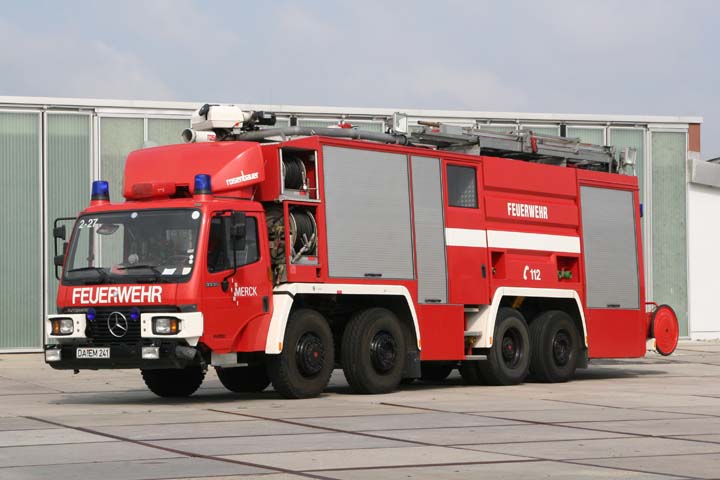
Merck Darmstadt Mercedes Rosenbauer
2-27 TroTLF Mercedes-Benz 3535/Rosenbauer DA-EM 241 1993
One of two Industrial Engines. The nickname is Iguana
2-27 TroTLF Mercedes-Benz 3535/Rosenbauer DA-EM 241 1993
One of two Industrial Engines. The nickname is Iguana
This picture is in the following groups
Werkfeuerwehr Merck Darmstadt, Germany
Werkfeuerwehr Merck Darmstadt, Germany
Here's some basic info:
Chassis: MB 3535
Bodywork: Rosenbauer (the cab itself was modified by Eller GmbH)
Manufactured: 1993
Water tank: 4000 l
Foam tank: 4000 l
ABC dry powder: 3000 kg
CO2: 300 kg
Pump output: 6000 lpm @ 8 bar
The crew cab in the middle of the bodywork has 4 seats (facing backwards, with BA sets fitted into the backrests). One additional BA set is mounted in the driver's cab. The water tank (and presumably the foam tank as well) is situated behind the crew cab, above the rear axels. A hosereel is mounted in the pump locker, above the pump's control panel. The powder and CO2 tanks are installed above the two front axles. There are 4 hosereels behind the driver's cab, 2 for each agent, on both sides (the smaller one for CO2 and the larger one for powder). There are two roof monitors. The vehicle is also fitted with a 'shower' system (decontamination purposes? the German description didn't say what it is for exactly!).
Data + info taken from: bos-fahrzeuge.info/einsatzfahrzeuge/41404/Florian_Merck_0227
Merck of Darmstadt is a major chemical and pharmaceutical company that produces, among others, liquid crystals for LCD displays, a variety of drugs, effect pigments, to name just a few. They also have a truly astonishing fleet of appliances at their industrial brigade, as one can see - without doubt some of the most curious, advanced, multi-purpose appliances ever delivered to any fire service in the world.
Added by Konrad Nowak on 10 March 2010.
Chassis: MB 3535
Bodywork: Rosenbauer (the cab itself was modified by Eller GmbH)
Manufactured: 1993
Water tank: 4000 l
Foam tank: 4000 l
ABC dry powder: 3000 kg
CO2: 300 kg
Pump output: 6000 lpm @ 8 bar
The crew cab in the middle of the bodywork has 4 seats (facing backwards, with BA sets fitted into the backrests). One additional BA set is mounted in the driver's cab. The water tank (and presumably the foam tank as well) is situated behind the crew cab, above the rear axels. A hosereel is mounted in the pump locker, above the pump's control panel. The powder and CO2 tanks are installed above the two front axles. There are 4 hosereels behind the driver's cab, 2 for each agent, on both sides (the smaller one for CO2 and the larger one for powder). There are two roof monitors. The vehicle is also fitted with a 'shower' system (decontamination purposes? the German description didn't say what it is for exactly!).
Data + info taken from: bos-fahrzeuge.info/einsatzfahrzeuge/41404/Florian_Merck_0227
Merck of Darmstadt is a major chemical and pharmaceutical company that produces, among others, liquid crystals for LCD displays, a variety of drugs, effect pigments, to name just a few. They also have a truly astonishing fleet of appliances at their industrial brigade, as one can see - without doubt some of the most curious, advanced, multi-purpose appliances ever delivered to any fire service in the world.
Added by Konrad Nowak on 10 March 2010.
Thanks for the info! I agree, Merck has some serious equipment in their brigade; some monster sized trucks to say the least.
Added by Len on 11 March 2010.
Added by Len on 11 March 2010.
Given the size of this monster, and with 4 axles, I a little surprised it doesn't carry more water. This is realizing that Merck is probably well supplied with hydrants. Thanks very much for the information on this super chemical foam pumper, Konrad.
Added by David L on 11 March 2010.
Added by David L on 11 March 2010.
Marcel & Konrad: thanks for showing and giving us the information on this huge rig. Hard to believe that a Fire Engine in Europe could be so big, and a Factory Fire Engine, too !
Added by Pat Rivers-Bowerman on 12 March 2010.
Added by Pat Rivers-Bowerman on 12 March 2010.
Major German manufacturing, refining and industrial plants are often equipped with very impressive high capacity trucks like this. These are specially designed for the risks at their facilities - and often with unique capabilities.
They are staffed by professional specially trained employees, and are sometimes called out to support municipal fire services when their equipment and/or training fill a requirement which the local authority service does not possess.
Similar conditions also exist in many other countries, and are similar to major airport fire services in most places. Very specialized, but ready to go "off base" when needed!
Added by Rob Johnson on 04 January 2019.
They are staffed by professional specially trained employees, and are sometimes called out to support municipal fire services when their equipment and/or training fill a requirement which the local authority service does not possess.
Similar conditions also exist in many other countries, and are similar to major airport fire services in most places. Very specialized, but ready to go "off base" when needed!
Added by Rob Johnson on 04 January 2019.
Mercedes-Benz


Added by Len on 10 March 2010.