
Upload a Picture
About this Site | Links | Random Pic | Advanced Search
Home | Latest Additions | Contributors
| Visitors
Fire Engine Photos
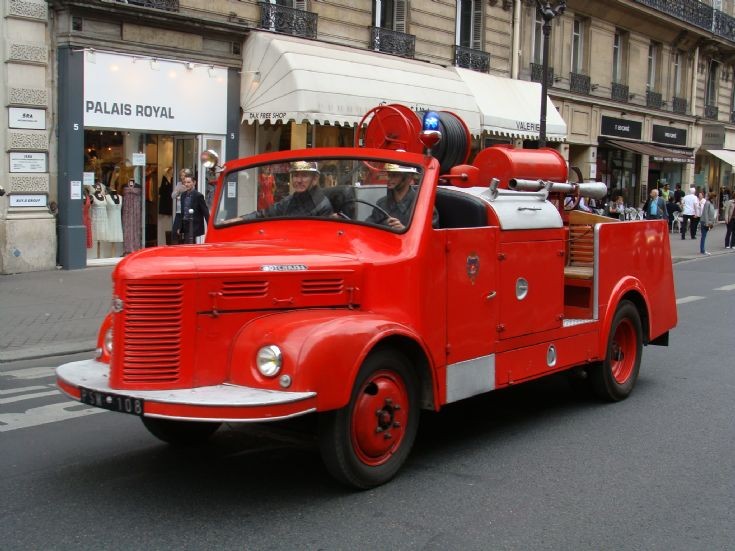
This is a "premier secours", designed for a crew of six. Two up front, and two sitting either side of each rear wheel arch, on the slatted wooden seats you can see in the picture, with the rear passengers facing backwards! They were intended as first response units, with a small pump, water tank, ladders and very basic equipment load.
Added by Rob Johnson on 01 April 2013.
Added by Rob Johnson on 01 April 2013.
Thanks, Rob. I think six men is the perfect crew for a pumper. Any more and it gets crowded, any less and effectiveness is reduced. Just one more question, the metal pipe located behind the driver looks like a foam branch. What is it?
Added by Tiger on 01 April 2013.
Added by Tiger on 01 April 2013.
It is indeed a foam branch. Interestingly, these first response pumpers in Paris shared quarters with Saviem and Berliet high-capacity pumps, which in those days carried a crew of no less than eleven members. You can see some examples on the Berliet manufacturer's pages on this site.
But in the 1920s and 1930s Paris' major pumps carried a crew of no less than fourteen! So the trend has been one of a gradual reduction over the years. Now it is down to eight, and is being progressively reduced to five on the newest units.
The Premier Secours light pump still has a crew of five, but is now configured as a combination fire appliance and emergency ambulance. Look on the Renault pages on this site.
Added by Rob Johnson on 02 April 2013.
But in the 1920s and 1930s Paris' major pumps carried a crew of no less than fourteen! So the trend has been one of a gradual reduction over the years. Now it is down to eight, and is being progressively reduced to five on the newest units.
The Premier Secours light pump still has a crew of five, but is now configured as a combination fire appliance and emergency ambulance. Look on the Renault pages on this site.
Added by Rob Johnson on 02 April 2013.
Well, Rob, like I said on the other page about the ambulance in Belgium, 6 men is a good number of crew for a pumper. Less and lives are put at risk. Although, in regional areas and smaller towns, five might be enough. Also, ladders and special appliances only need a crew to two to three, as do ambulances.
Added by Tiger on 02 April 2013.
Added by Tiger on 02 April 2013.
By the way, I own a book caled "German Firefighting Vehicles in WWII" and it says that in the major cities such as Berlin, Hamburg and Stuttgart, the pumps could have crews numbering up to eleven men. Large crews seem to have been a trend around that time.
Added by Tiger on 02 April 2013.
Added by Tiger on 02 April 2013.
Hotchkiss


Added by Tiger on 31 March 2013.