
Upload a Picture
About this Site | Links | Random Pic | Advanced Search
Home | Latest Additions | Contributors
| Visitors
Fire Engine Photos
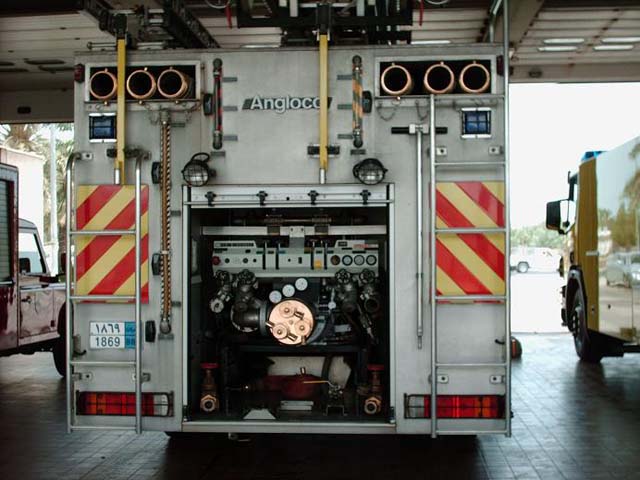
Rob, do they use above ground bulk storage tanks as primary / secondary water supplies in some areas? If so, presumably these tanks are fitted with 140mm FRT suction outlets to enable appliances to couple up using the hard suction? I know this concept is used on some industrial sites in the UK as back up in the event of primary supply failure, with 140mm to 100mm suction adaptors being available to enable any local authority appliances fitted with the smaller 100mm pump inlets to likewise couple up if needs be. Just a thought.
Added by Keith Richardson on 21 August 2012.
Added by Keith Richardson on 21 August 2012.
Its a good thought, but I don't know if it is actually the SOP there. In Kuwait, which has a very limited network of hydrants, the fire service simply relied on tankers, and they had a huge fleet of both 2 axle, 3 axle and 5 axle (tractor-trailer) tankers.
Here in the US, tankers are very common in rural areas. But we also have "dry hydrants" in some places, which are underground tanks fed by the storm drains to collect runoff rain water. These too require the use of suction hoses, and can hold up to 60, 000 liters, although sizes vary.
Another idea in some affluent communities without water mains is to plumb a dry street hydrant in to a swimming pool, so the pumper can draft from the pool, without having to crash through walls and fences to get access to it! Of course, this solution only works in the warmer areas of the country where pools are in use year round.
Added by Rob Johnson on 21 August 2012.
Here in the US, tankers are very common in rural areas. But we also have "dry hydrants" in some places, which are underground tanks fed by the storm drains to collect runoff rain water. These too require the use of suction hoses, and can hold up to 60, 000 liters, although sizes vary.
Another idea in some affluent communities without water mains is to plumb a dry street hydrant in to a swimming pool, so the pumper can draft from the pool, without having to crash through walls and fences to get access to it! Of course, this solution only works in the warmer areas of the country where pools are in use year round.
Added by Rob Johnson on 21 August 2012.
I suppose we could get a definitive answer by asking Angloco. Having a lot of experience of building appliances for Middle East use, and having built this one, presumably they would know why 140mm suction was included in the spec?
Added by Keith Richardson on 22 August 2012.
Added by Keith Richardson on 22 August 2012.
Scania


Added by Rob Johnson on 20 August 2012.