
Upload a Picture
About this Site | Links | Random Pic | Advanced Search
Home | Latest Additions | Contributors
| Visitors
Fire Engine Photos
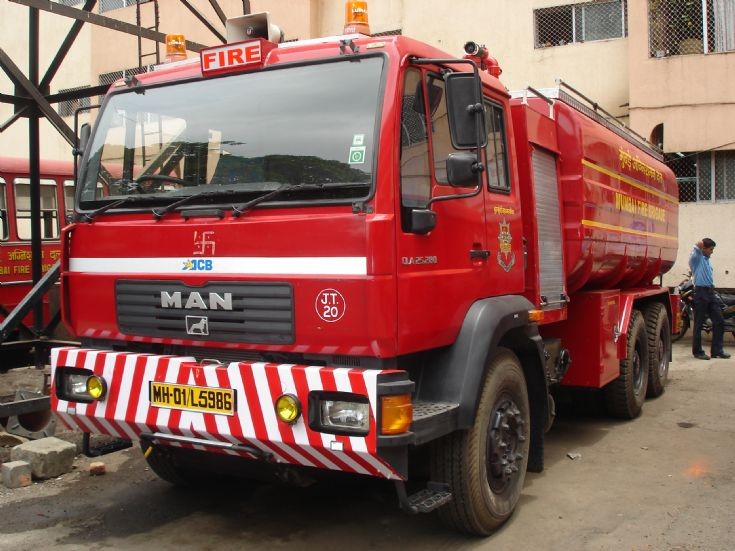
At a recent eight pump fire, seven of these JTs were also in attendance. In earlier years, it might have required the attendance of 20 or more pump appliances relaying water by shuttle - around 25% of the entire brigade's fleet.
Congested street conditions in many areas inhibit the use of hose relays, and traffic congestion can result in 20 to 30 minute response times in outlying areas.
For these reasons, Mumbai is adopting a Japanese practice, which is to use motorcycles with self-contained 80 liter water tanks and hose reels to get two firefighters to incidents much more quickly. Pump crews are seven. Now two will ride the bikes and the remaining five will follow up with the pump.
Incidentally, most of the newer pumps are MAN, although locally built Tata appliances are still in daily use too...
Added by Rob Johnson on 26 May 2020.
Congested street conditions in many areas inhibit the use of hose relays, and traffic congestion can result in 20 to 30 minute response times in outlying areas.
For these reasons, Mumbai is adopting a Japanese practice, which is to use motorcycles with self-contained 80 liter water tanks and hose reels to get two firefighters to incidents much more quickly. Pump crews are seven. Now two will ride the bikes and the remaining five will follow up with the pump.
Incidentally, most of the newer pumps are MAN, although locally built Tata appliances are still in daily use too...
Added by Rob Johnson on 26 May 2020.
MAN


All Mumbai pumpers carry 4500 liters of water, as the hydrant system in many areas can be very limited, but big fires historically required the inevitable attendance of numerous pump appliances to ensure adequate water supplies.
Because of this, the brigade acquired a fleet of 14, 000 and 20, 000 liter tankers on Mercedes and MAN chassis.
Since then, these units can now make up for compromised water availability at major incidents without calling out too many extra pump appliances.
Added by Rob Johnson on 23 May 2020.