
Upload a Picture
About this Site | Links | Random Pic | Advanced Search
Home | Latest Additions | Contributors
| Visitors
Fire Engine Photos
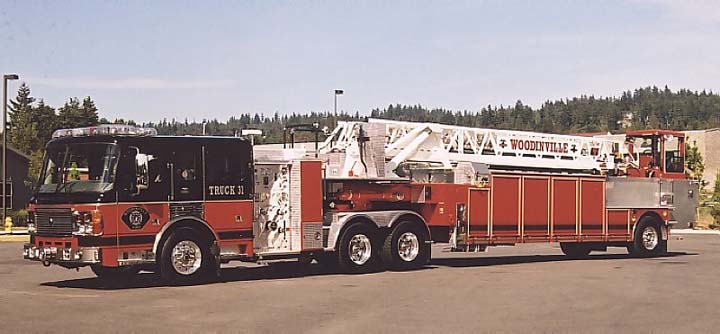
No: 2547 Contributor: Shane MacKichan Year: 2007 Manufacturer: American LaFrance Country: United States of America
Now, there is an ARP/CARP, to get around in - for the "bean-counters" in Britain, that drive Fire Brigades up the stick, with their patent cost-cutting ideas.......
Regards, from Canada,
Pat_R-B
Added by Pat Rivers-Bowerman on 09 October 2008.
Regards, from Canada,
Pat_R-B
Added by Pat Rivers-Bowerman on 09 October 2008.
Why is this vehicle so big? Is it (as I believe) just the Americans saying 'Look at us!' After all, this rig operates at the same height as a European TL. Fair enough it's got a pump, and no doubt a powerful one at that, but why-o-why does it need to be so huge? Perhaps Yankee tenders share the same growth capabilities as a carp (the fish and not the fire appliance). A carp will grow to a size dictated by the size of its pond -- wide roads with not a bend in sight, sprawling cities, bottomless budgets, dirt-cheap fuel . . . and bingo, another beast hits the streets.
Added by Yelp Bullhorn on 10 October 2008.
Added by Yelp Bullhorn on 10 October 2008.
I have to agree Yelp, and the overkill of adding a pump. I think it demonstrates that we also build to a budget and for urban considerations ie road size and width, this machine would get stuck in most European cities, in a word, its an ego trip on wheels.
Added by John Stott on 11 October 2008.
Added by John Stott on 11 October 2008.
The reason this rig has a tiller (rear driver) is because the streets are probably very narrow and even a shorter European truck might not make the turns. Also, please note that this vehicle has seating for a minuimum 5 if not more. Most of the European trucks have seating for 2 maybe 3. Also as you mentioned this truck has a pump on it and significantly more compartment space than any European trucks I have seen.
Hopee this helps
Added by Todd on 12 October 2008.
Hopee this helps
Added by Todd on 12 October 2008.
Location - Station 31, Woodinville Fire & Life Safety District, King County(lies around Seattle to east), State of Washington, Pacific Coast of U.S.A.
Woodinville, Pop. 9, 194, lies in the lush Sammamish(yep, Indian Tribe) Valley, North-East of Seattle. Wine district.
This Truck appears to run as a Pumper and a Ladder, no Rescue; as it shares Station 31 with a Rescue Truck and 2 Aid Cars. There are 3 other Stations, each with a Pumper and an Aid Car.
It would be a welcome sight for Mutual Aid in King County, with its "big stick" and 1500 gpm [5678 lpm] pump; carrying Relief Crew in that big cab; and its size and speed for handling the highway traffic.
No "Home Office" here - the local municipal taxes pay in directly for Fire Service; so for some interesting reading on running an American Fire Dept, have a look at the 2007 Fire Chief's Annual Report:
www.wflsd.org/Annual_Report2007.pdf
Regards, from Canada,
Pat_R-B
Added by Pat Rivers-Bowerman on 17 October 2008.
Woodinville, Pop. 9, 194, lies in the lush Sammamish(yep, Indian Tribe) Valley, North-East of Seattle. Wine district.
This Truck appears to run as a Pumper and a Ladder, no Rescue; as it shares Station 31 with a Rescue Truck and 2 Aid Cars. There are 3 other Stations, each with a Pumper and an Aid Car.
It would be a welcome sight for Mutual Aid in King County, with its "big stick" and 1500 gpm [5678 lpm] pump; carrying Relief Crew in that big cab; and its size and speed for handling the highway traffic.
No "Home Office" here - the local municipal taxes pay in directly for Fire Service; so for some interesting reading on running an American Fire Dept, have a look at the 2007 Fire Chief's Annual Report:
www.wflsd.org/Annual_Report2007.pdf
Regards, from Canada,
Pat_R-B
Added by Pat Rivers-Bowerman on 17 October 2008.
Hi Todd! Sorrrrry, but i'm not impressed at all!
Anders F.Sweden.
Added by Anders Fallström on 21 August 2015.
Anders F.Sweden.
Added by Anders Fallström on 21 August 2015.
American LaFrance


Added by RICHARD J SIKORA on 29 March 2007.