
Upload a Picture
About this Site | Links | Random Pic | Advanced Search
Home | Latest Additions | Contributors
| Visitors
Fire Engine Photos
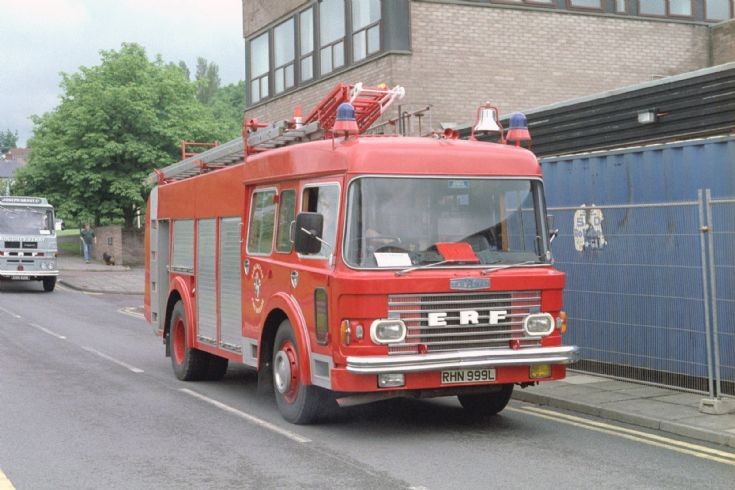
When this appliance was used as a display appliance the tank and pump were still intact. The only thing, was that the escape was bolted to the appliance and it did not carry any kit.
Added by Paul Staniland on 27 February 2010.
Added by Paul Staniland on 27 February 2010.
Here's a couple of questions regarding preserved appliances that I've never found the answer to,and always get different responses to whenever I ask.
The questions are,'If a preserved machine happens to come across a fire situation before the brigade gets there,is it expected to help out?' and 'are preserved fire engines required to be fully operational?'.
Added by Chris Hall Teesside. UK. on 28 February 2010.
The questions are,'If a preserved machine happens to come across a fire situation before the brigade gets there,is it expected to help out?' and 'are preserved fire engines required to be fully operational?'.
Added by Chris Hall Teesside. UK. on 28 February 2010.
No and No Chris.....my one dread driving and old machine round the countryside is coming onto a working job, its perception isn't it....the public would expect ! Often I am on my own and although I am capable of getting a hose reel to work alone we don't usually carry water in our tanks. I am aware that some preserved pumps go out fully crewed and equipped and I am aware that they have 'got to work' when finding these situations, there are also the old elfandsafety issues to consider too. Its an area fraught with difficulties, even a bog standard car fire which I suppose is the most common fire we would come across in our travels can be complicated with exploding air bags and gas struts etc....its quite a dilemma, you feel that you should do something and not just drive past but I guess the best advice must be leave the professional firefighting to the professionals.
Added by Barrie Green on 28 February 2010.
Added by Barrie Green on 28 February 2010.
Thanks for the info Barrie, I suppose we won't know for sure until an incident happens, and we see what implications actually do arise from it.
Added by Chris Hall Teesside. UK. on 28 February 2010.
Added by Chris Hall Teesside. UK. on 28 February 2010.
Thanks Chris for asking that question; I was curious my-self, where this 'Site shows so many fully-restored fire-engines, with all their gear aboard, travelling the land in show-season, and in private ownership.
Over here, very sparse; most of preserved engines are with Fire Departments, or a static museum piece. Those in private ownership, if not rusting away in the junk-yard; have been radically altered into another working vehicle that is obviously not a fire-engine anymore.
Regards, from Canada,
Pat_R-B
Added by Pat Rivers-Bowerman on 01 March 2010.
Over here, very sparse; most of preserved engines are with Fire Departments, or a static museum piece. Those in private ownership, if not rusting away in the junk-yard; have been radically altered into another working vehicle that is obviously not a fire-engine anymore.
Regards, from Canada,
Pat_R-B
Added by Pat Rivers-Bowerman on 01 March 2010.
It seems to be carrying a Merryweather steel ladder, but its predecessor Dennis F12 PHN 999 had a good old fashioned wooden escape ladder.
Did this ERF have a 300 gallon tank, like some others which were designed around the lighter steel ladder?
Added by Rob Johnson on 28 July 2017.
Did this ERF have a 300 gallon tank, like some others which were designed around the lighter steel ladder?
Added by Rob Johnson on 28 July 2017.
It seems to be carrying a Merryweather steel ladder, but its predecessor - Dennis F12 PHN 999 - had a good old fashioned wooden escape ladder.
Did this ERF have a 300 gallon tank, like some others, which were designed around the lighter steel ladder?
Added by Rob Johnson on 28 July 2017.
Did this ERF have a 300 gallon tank, like some others, which were designed around the lighter steel ladder?
Added by Rob Johnson on 28 July 2017.
The escape ladder was changed to a Merryweather all steel ladder prior to Training School. I used the machine at training School. It was brilliant to climb and pumped well. It had hook ladders originally. It was replaced at Darlington by a Dennis with a 464 ladder.
Added by Mike Andrews on 04 November 2017.
Added by Mike Andrews on 04 November 2017.
The ERF came new with the steel escape and never carried the wooden Bayley escape.
Added by Ronald Henderson on 08 November 2017.
Added by Ronald Henderson on 08 November 2017.
Thanks Ronald:
I should have just asked you!
I only saw this unit once, but I did get a good look at the one in - of all places - the Phoenix Hall of Flame. This had a 500 GPM pump and a 300 gallon tank, which I suspect was made possible by the lighter weight of the steel escape ladder. I guess this combination was a bit more practical than the 1000 GPM pump and 100 gallon tank on the earlier versions, such as the Newcastle prototype.
There are some London ERF PEs on this site with the Merryweather steel ladder too. Do you know if these were 500/300 as well?
Added by Rob Johnson on 09 November 2017.
I should have just asked you!
I only saw this unit once, but I did get a good look at the one in - of all places - the Phoenix Hall of Flame. This had a 500 GPM pump and a 300 gallon tank, which I suspect was made possible by the lighter weight of the steel escape ladder. I guess this combination was a bit more practical than the 1000 GPM pump and 100 gallon tank on the earlier versions, such as the Newcastle prototype.
There are some London ERF PEs on this site with the Merryweather steel ladder too. Do you know if these were 500/300 as well?
Added by Rob Johnson on 09 November 2017.
Sorry for the tardy response Rob. Forgot. The London ERF's had 1000gpm umps and 300 galons of water.
Added by Ronald Henderson on 27 November 2017.
Added by Ronald Henderson on 27 November 2017.
The Darlington Metal Merryweather Escape was a replacement for the original wooden Ajax Escape on the F12 in 1966 as I have a bill for fuel after the F12 went to collect it from Merryweather's Greenwich Works !
Added by Brett Clayton on 28 November 2017.
Added by Brett Clayton on 28 November 2017.
Quite a few gallons I suspect. The B80 was both powerful and mighty, but not exactly economical!
Added by Rob Johnson on 29 November 2017.
Added by Rob Johnson on 29 November 2017.
ERF


Added by Barrie Green on 26 February 2010.