
Upload a Picture
About this Site | Links | Random Pic | Advanced Search
Home | Latest Additions | Contributors
| Visitors
Fire Engine Photos
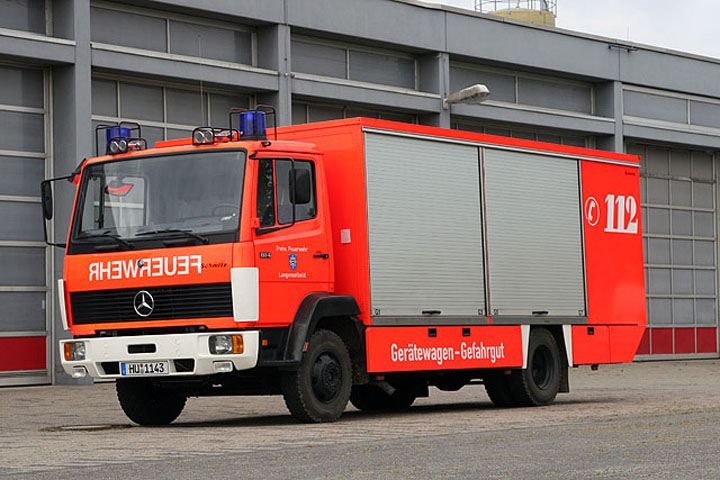
Image of the Haz-Mat unit Langenselbold Germany
This is a 1996 Mercedes Benz 814 D Ecoliner, built by the German firm Schmitz. This unit is used when there are accidents with hazardous material.
This is a 1996 Mercedes Benz 814 D Ecoliner, built by the German firm Schmitz. This unit is used when there are accidents with hazardous material.
This picture is in the following groups
Feuerwehr Langenselbold, Germany
Feuerwehr Langenselbold, Germany
Normally the Crew is 3 Persons. Extra seat in the Middel. Difficult with Helmet ;)
Added by Aaldert Koster on 02 December 2013.
Added by Aaldert Koster on 02 December 2013.
German hazmat units acan be staffed by one, two, or three, and are usually jump-manned by firefighters assigned primarily to other apparatus, except of course at all-volunteer stations.
Added by Rob Johnson on 02 December 2013.
Added by Rob Johnson on 02 December 2013.
Rob, I served at a Voluntary Fire Brigade in Germany and we had a similar Hazmat truck as shown here. We staffed it with a minimum of 2 but normally 3 crewmembers. I don't know how it is done at the Professional Fire Brigades, but the Voluntary Brigades will use the full capacity of crew. You need these persons to manage this Unit.
Added by Aaldert Koster on 03 December 2013.
Added by Aaldert Koster on 03 December 2013.
Aaldert - Many Berufsfeuerwehr organizations staff HazMat units with firefighters who also jump man other specialized units, depending on the call.
Berlin, for example, has two very large technical specialist fire stations, where the vast majority of specialist trucks and AB pods are atationed, whilst rescue pumpers, ambulances, ladders and command vans are spread around stations all over the city.
These tecnical stations have extra personnel with special training, but the manning level of any single unit can vary - depending on what is called out and how many personnel are free to man them at any one time. Just like your fire company, they normally strive to man the HazMat Unit with two or three, but sometimes it will be operated by only one person.
Other large cities often have an AB system HazMat Unit, carried on a WLF transporter, and in these cases the staffing can also be variable.
Of course, the primary role of these units is to bring equipment to an incident, which will be used by appropriately-trained personnel responding on pump appliances. A few fire departments, especially in the US and Japan, have hazmat trucks with a crew cab to accommodate up to six specially-trained hazmat personnel, but this is unusual in most of the rest of the World.
Added by Rob Johnson on 03 December 2013.
Berlin, for example, has two very large technical specialist fire stations, where the vast majority of specialist trucks and AB pods are atationed, whilst rescue pumpers, ambulances, ladders and command vans are spread around stations all over the city.
These tecnical stations have extra personnel with special training, but the manning level of any single unit can vary - depending on what is called out and how many personnel are free to man them at any one time. Just like your fire company, they normally strive to man the HazMat Unit with two or three, but sometimes it will be operated by only one person.
Other large cities often have an AB system HazMat Unit, carried on a WLF transporter, and in these cases the staffing can also be variable.
Of course, the primary role of these units is to bring equipment to an incident, which will be used by appropriately-trained personnel responding on pump appliances. A few fire departments, especially in the US and Japan, have hazmat trucks with a crew cab to accommodate up to six specially-trained hazmat personnel, but this is unusual in most of the rest of the World.
Added by Rob Johnson on 03 December 2013.
Thanks, guys. You have all been very informative! I have noticed lately that cross-crewing, or jump-manning, is becoming increasingly common in many brigades around the world.
Added by Tiger on 05 December 2013.
Added by Tiger on 05 December 2013.
Quite right!
I think there are three main reasons for this phenomenon.
1- Fire and rescue services are continually putting increasing numbers of very specialized units into service, but many of these are actually needed only very infrequently. Because there are practical limits to how large firefighting trucks can become, this means both bigger multi-purpose units as well as more and more different types of trucks. But it is often not an affordable solution to provide a dedicated crew on a vehicle which may only get called once or twice a week.
This is another reason why the Geramn concept of a WLF pod carrier and a selection of AB pods is now spreading around the World. It not only saves personnel costs, but eliminates the capital and maintenance costs of extra chassis.
2- The other motivation is the cost of staffing. My local fire station in Chicago is Engine 13, Truck 6 and Batallion 1. This is normally staffed by twelve members. But they also have the responsibility of crewing the city's two fireboats and they additionally constitute the CFD's SCUBA Dive Team.
Having dedicated personnel for these extra roles would be difficult to justify, and the same goes for CFS's extensive fleet of other rarely-used special-purpose units.
What is worrisome is that in some jurisdictions, jump manning is purely a cost-saving measure. I recently walked into a fire station in a large US city (no names!) with an engine, a ladder truck and an ambulance - only to meet BOTH members of the entire duty watch. All they could do was to ride one of the three vehicles, and hope they would not be all alone for too long! Not only did this department have stations with ridiculous and dangerous levels of undermanning, they had no recall protocol for off-duty personnel, because they did not want to pay overtime.
3- Many fire services in different countries are experiencing alarming growth in EMS calls. This often results in some ambulances being crewed by firefighters - who would otherwise be riding fire trucks. The city of Berlin used to have an extensive jump manning protocol, but found that the demand for EMS ambulances all too often reduced rescue pump crews from six to four. This, in turn, meant that three pumps were required to attend structure fires instead of only two, to insure a total of sixteen responders including the aerial ladder and command van. Because the growth of EMS calls was unstoppable, and fire calls were declining, the number of pumpers was reduced. This had the ironical effect of actually improving fire cover - because fewer stations ended up being emptied out. Berlin also has 54 volunteer fire companies, which can (and often do) take up the slack, but do not provide EMS capabilities.
Added by Rob Johnson on 05 December 2013.
I think there are three main reasons for this phenomenon.
1- Fire and rescue services are continually putting increasing numbers of very specialized units into service, but many of these are actually needed only very infrequently. Because there are practical limits to how large firefighting trucks can become, this means both bigger multi-purpose units as well as more and more different types of trucks. But it is often not an affordable solution to provide a dedicated crew on a vehicle which may only get called once or twice a week.
This is another reason why the Geramn concept of a WLF pod carrier and a selection of AB pods is now spreading around the World. It not only saves personnel costs, but eliminates the capital and maintenance costs of extra chassis.
2- The other motivation is the cost of staffing. My local fire station in Chicago is Engine 13, Truck 6 and Batallion 1. This is normally staffed by twelve members. But they also have the responsibility of crewing the city's two fireboats and they additionally constitute the CFD's SCUBA Dive Team.
Having dedicated personnel for these extra roles would be difficult to justify, and the same goes for CFS's extensive fleet of other rarely-used special-purpose units.
What is worrisome is that in some jurisdictions, jump manning is purely a cost-saving measure. I recently walked into a fire station in a large US city (no names!) with an engine, a ladder truck and an ambulance - only to meet BOTH members of the entire duty watch. All they could do was to ride one of the three vehicles, and hope they would not be all alone for too long! Not only did this department have stations with ridiculous and dangerous levels of undermanning, they had no recall protocol for off-duty personnel, because they did not want to pay overtime.
3- Many fire services in different countries are experiencing alarming growth in EMS calls. This often results in some ambulances being crewed by firefighters - who would otherwise be riding fire trucks. The city of Berlin used to have an extensive jump manning protocol, but found that the demand for EMS ambulances all too often reduced rescue pump crews from six to four. This, in turn, meant that three pumps were required to attend structure fires instead of only two, to insure a total of sixteen responders including the aerial ladder and command van. Because the growth of EMS calls was unstoppable, and fire calls were declining, the number of pumpers was reduced. This had the ironical effect of actually improving fire cover - because fewer stations ended up being emptied out. Berlin also has 54 volunteer fire companies, which can (and often do) take up the slack, but do not provide EMS capabilities.
Added by Rob Johnson on 05 December 2013.
Interesting, Rob.
My hometown, Linz, is one of the few in Austria (Europe) which have a professional fire fighting service. Crews are rotated through the trucks, meaning Monday you are on a rescue, Tuesday e.g. on a pumper etc. This helps keeping the training level up on all equipment. Trucks always leave stations fully manned.
EMS and ambulance service is not done by fire fighters here. Other organisations like the Red Cross provide these services. They depend like fire fighting to a large degree on volunteers and/or young people who chose to do civil service instead of Army service.
In Linz we also have a combined command/Hazmat unit which is on a trailer. It also has an independent power unit. I think I have a photo somewhere if someone are interested in seeing it.
Added by Martin Siegel on 06 December 2013.
My hometown, Linz, is one of the few in Austria (Europe) which have a professional fire fighting service. Crews are rotated through the trucks, meaning Monday you are on a rescue, Tuesday e.g. on a pumper etc. This helps keeping the training level up on all equipment. Trucks always leave stations fully manned.
EMS and ambulance service is not done by fire fighters here. Other organisations like the Red Cross provide these services. They depend like fire fighting to a large degree on volunteers and/or young people who chose to do civil service instead of Army service.
In Linz we also have a combined command/Hazmat unit which is on a trailer. It also has an independent power unit. I think I have a photo somewhere if someone are interested in seeing it.
Added by Martin Siegel on 06 December 2013.
Mercedes-Benz


Added by Tiger on 02 December 2013.