
Upload a Picture
About this Site | Links | Random Pic | Advanced Search
Home | Latest Additions | Contributors
| Visitors
Fire Engine Photos
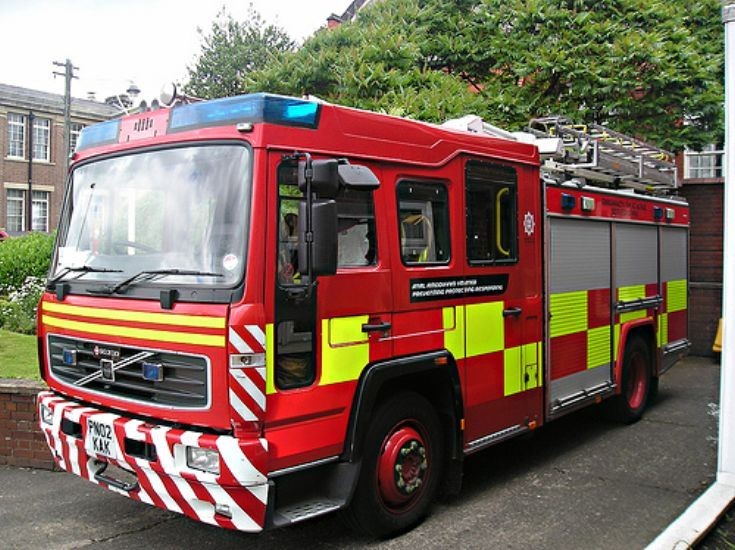
1st away is 1st punp to respond to a call,2nd away the 2nd to go out, and in Wrexhams case (only 3 pump station in Wales) 3rd away 3rd to go out.
Added by Gary Simpson on 24 March 2010.
Added by Gary Simpson on 24 March 2010.
At some fire stations with two pumping appliances, just one of the pumping appliances may be manned by wholetime firefighters; the other, say, by retained staff. In which case if a call comes in, that particular fire appliance will be the first (and sometimes only) appliance to respond. If the call requires both pumps, then the retained crew will turn up at the station and man the other appliance which will then respond, and will quite literally be the 'second-away'.
At stations where both pumps are manned equally, the first-away is normally first-away because it carries the larger ladder which is vital if responding to a building fire. Or if responding to a road accident, it is first-away because it also normally carries the hydraulic rescue/cutting equipment.
At three-pump stations, the third-away is manned by retained firefighters and (usuallly) the other two pumps by full-time staff; so the third-away only responds when the other two are otherwise engaged, or as third-away to an incident that requires three pumps. So it merely refers to the turn-out order of the main fire-fighting appliances.
Added by Yelp Bullhorn on 24 March 2010.
At stations where both pumps are manned equally, the first-away is normally first-away because it carries the larger ladder which is vital if responding to a building fire. Or if responding to a road accident, it is first-away because it also normally carries the hydraulic rescue/cutting equipment.
At three-pump stations, the third-away is manned by retained firefighters and (usuallly) the other two pumps by full-time staff; so the third-away only responds when the other two are otherwise engaged, or as third-away to an incident that requires three pumps. So it merely refers to the turn-out order of the main fire-fighting appliances.
Added by Yelp Bullhorn on 24 March 2010.
Thank you very much.
Added by James on 24 March 2010.
Added by James on 24 March 2010.
James, I'am In the same boat as you. 20 years in the fire service and I have never heard of this saying either.
Added by Simon Gunning on 24 March 2010.
Added by Simon Gunning on 24 March 2010.
Haha, okay at least there is someone in the same boat as me. Thanks.
Added by James on 24 March 2010.
Added by James on 24 March 2010.
James, when I say never heard of this, I refer to the brigade I'am serving in doesn't use this terminology.
Sorry if I confused the issue.
Added by Simon Gunning on 24 March 2010.
Sorry if I confused the issue.
Added by Simon Gunning on 24 March 2010.
Simon i am the same was in 28years and we never used these sayings, seams it is one some brigades may use were there are retained crews.
Added by Dave Price on 25 March 2010.
Added by Dave Price on 25 March 2010.
I was thirty years in the service, twenty of those were with Clwyd and North Wales and the term was never used in that time. It is even less applicable to Wrexham where they have two whole-time crewed appliances, either one of which could be mobilised individually, so this term means nothing.
Added by Dusty on 25 March 2010.
Added by Dusty on 25 March 2010.
I may be wrong but I seem to remember it being a LFB term.....
Added by Barrie Green on 25 March 2010.
Added by Barrie Green on 25 March 2010.
I may have lost something in the translation Dusty, but I never said that this was a term specific to Clwyd or NWFRS did I? It is a description NOT a biblical statement. I believe you are not far away from the truth Barrie, it was a term used by the NFS/AFS also, and I believe carried on from there. It might mean nothing to some but its nice that they feel compelled to pass judgement.
P.S. I had two uncles who served in Clwyd and its predecessors,and I did 5 years in Clwyd, I and one of them had not heard much of it but 1 ex NFS and Flintshire used it to describe other stations 2nd or 3rd appliances (Rhyl,Deeside etc) regularly.
Added by Gary Simpson on 26 March 2010.
P.S. I had two uncles who served in Clwyd and its predecessors,and I did 5 years in Clwyd, I and one of them had not heard much of it but 1 ex NFS and Flintshire used it to describe other stations 2nd or 3rd appliances (Rhyl,Deeside etc) regularly.
Added by Gary Simpson on 26 March 2010.
In the UK I believe 'first-away' and 'second-away' are terms used more-so by fire engine enthusiasts to differentiate between appliances kept at a particular station. I believe it is a term from over-the-pond. And I think it is relatively unkown within 'The Brigade' over here.
Added by Yelp Bullhorn on 27 March 2010.
Added by Yelp Bullhorn on 27 March 2010.
I did'nt really want to get to involved in this particular discussion on 1st away/2nd away, but in West Sussex going back to the sixties and to this present day this terminology is still used.
I think it really though dates way back when there would have been a pump escape and pump on station (in other words-PE and P or later WRL and WRT). The 1st away would have been the PE(WRL) which would posible have 5/6 riders/carried a 50ft ladder/rescue equipment,etc.The 2nd away would have been the pump (P-WRT) which rode 4/5? and just carried a standard 35ft ladder, no rescue equipment and standard firefighting equipment.
Today, most appliances (WRL's,DPL's,RPL's-what ever you might like to call them) in most brigades carry the standard 135(50ft)ladder, rescue equipment, as well as the standard carrying of firefighting equipment,ie: -hose, chimney gear and breathing apparatus,etc. Going way back though, at one time only one appliance (1st away) would have carried BA,especially on a 2 pump retained station.The 1st away also would have been the only appliance to have carried the rescue gear on the station.
I'm sure someone else will add more to this discussion,but I just thought I'd have my say on how I think the saying came about.
Added by Pete Matten on 27 March 2010.
I think it really though dates way back when there would have been a pump escape and pump on station (in other words-PE and P or later WRL and WRT). The 1st away would have been the PE(WRL) which would posible have 5/6 riders/carried a 50ft ladder/rescue equipment,etc.The 2nd away would have been the pump (P-WRT) which rode 4/5? and just carried a standard 35ft ladder, no rescue equipment and standard firefighting equipment.
Today, most appliances (WRL's,DPL's,RPL's-what ever you might like to call them) in most brigades carry the standard 135(50ft)ladder, rescue equipment, as well as the standard carrying of firefighting equipment,ie: -hose, chimney gear and breathing apparatus,etc. Going way back though, at one time only one appliance (1st away) would have carried BA,especially on a 2 pump retained station.The 1st away also would have been the only appliance to have carried the rescue gear on the station.
I'm sure someone else will add more to this discussion,but I just thought I'd have my say on how I think the saying came about.
Added by Pete Matten on 27 March 2010.
Gents, this was a common term used in New Zealand in the sixties. Particularly for a major station like the Pitt Street Headquarters in Auckland with an eight-bay engine room, two rows of four bays.
The Number 1 pump was always first-away to all calls and was positioned front left. Second-away would be Number 2 pump (2nd left in engine room). I'm getting a little fuzzy now but I think third-away was the ET positioned far right (Bay 4) and fourth-away would be the turntable ladder (third bay front).
Fifth-away would be Number 3 pump (when we had the crew) and was housed bay 6 (second left second row). (The Executive Officer's Control Car was positioned Bay 5 behind No 1.
Now I know why Pete Matten didn't want to get into this...
But the main reason was there needed to be some order when turning out (charging out the front doors like a bat out of hell!). The first, second-away, etc, allowed for no mishaps as the appliances made the sharp turn to head up town, or right to head down town on Pitt Street, or even harder right again to head down the roller-coaster steep hill ride of Greys Avenue!
Low and behold if you didn't go out in strict order you'd be cleaning toilets and bathrooms for months! The only exception was if one of the machines stalled or failed to start immediately you were permitted to jump the queue.
You must remember in those days it was a competition to be the fastest crew ready to turn-out and from bells going down we would be all clear of the engine room in seconds, leaving only the smell of exhaust fumes and electric cords dangling in our wake!
Oh, those were the days,,,,
Added by Pav on 27 March 2010.
The Number 1 pump was always first-away to all calls and was positioned front left. Second-away would be Number 2 pump (2nd left in engine room). I'm getting a little fuzzy now but I think third-away was the ET positioned far right (Bay 4) and fourth-away would be the turntable ladder (third bay front).
Fifth-away would be Number 3 pump (when we had the crew) and was housed bay 6 (second left second row). (The Executive Officer's Control Car was positioned Bay 5 behind No 1.
Now I know why Pete Matten didn't want to get into this...
But the main reason was there needed to be some order when turning out (charging out the front doors like a bat out of hell!). The first, second-away, etc, allowed for no mishaps as the appliances made the sharp turn to head up town, or right to head down town on Pitt Street, or even harder right again to head down the roller-coaster steep hill ride of Greys Avenue!
Low and behold if you didn't go out in strict order you'd be cleaning toilets and bathrooms for months! The only exception was if one of the machines stalled or failed to start immediately you were permitted to jump the queue.
You must remember in those days it was a competition to be the fastest crew ready to turn-out and from bells going down we would be all clear of the engine room in seconds, leaving only the smell of exhaust fumes and electric cords dangling in our wake!
Oh, those were the days,,,,
Added by Pav on 27 March 2010.
Either retained at Holyhead, Rhyl or Llandudno
Added by Simon Roberts on 18 April 2012.
Added by Simon Roberts on 18 April 2012.
Rhyl retained now, PN02KAO is Llandudno retained pump, KAO was Previously at Johnstown.
Added by Gary Simpson on 19 April 2012.
Added by Gary Simpson on 19 April 2012.
These have been replaced at rhyl and st asaph by Mercedes ategos rhyl retained runs DK57 CPZ as of 7/12/15
Added by Steven Hughes on 08 December 2015.
Added by Steven Hughes on 08 December 2015.
Up here in sunny Scotland on most full-time stations with a 2 WT appliance &/or 3rd Ret crew) where 1st & 2nd have WC (old Stn O rank) CC (old Sub O) although the appliances are numerically numbered Papa1, Papa2 etc, often the 2nd is first away to most turn outs unless it's a PDA of 2/3 within the cities, Glasgow, Edinburgh, Dundee etc. Which can be confusing. But as Dusty along with others had said, it's more a reference to what turns out when & what to & refers back to the days of PEs, Ps etc.
Added by Simon Cunningham on 29 January 2025.
Added by Simon Cunningham on 29 January 2025.
Volvo


Added by James on 23 March 2010.