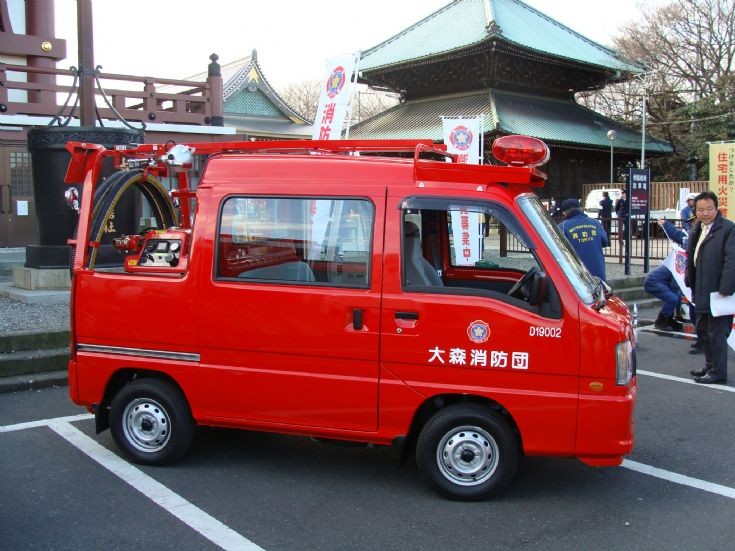
In addition to 80 large full time stations, Tokyo has over 200 community volunteer stations. Most of them have these diminutive pumpers, which are able to get all the way into the very narrow streets, alleys and back lanes in their very crowded and congested suburban response areas.
These consist almost exclusively of closely-packed buildings, which are typically constructed either mostly or entirely of wood, and as a result the risk of conflagration is very real.
The volunteers respond - along with the professional firefighters - in great numbers and serve mainly to protect exposures by surrounding the fire scene on all sides, leaving more complex tasks to the full time crews with their much more specialized equipment.
Often showing up with five or even ten of these tiny pumpers, they use the portable pump to access a hydrant or underground water tank, and run out a single line with a 250 to 450 LPM nozzle. The crew is up to four, but even with only two they can get everything working. They do not have BA, and never undertake interior attacks or rescue activities - which are the domain of the full-time responders.



These consist almost exclusively of closely-packed buildings, which are typically constructed either mostly or entirely of wood, and as a result the risk of conflagration is very real.
The volunteers respond - along with the professional firefighters - in great numbers and serve mainly to protect exposures by surrounding the fire scene on all sides, leaving more complex tasks to the full time crews with their much more specialized equipment.
Often showing up with five or even ten of these tiny pumpers, they use the portable pump to access a hydrant or underground water tank, and run out a single line with a 250 to 450 LPM nozzle. The crew is up to four, but even with only two they can get everything working. They do not have BA, and never undertake interior attacks or rescue activities - which are the domain of the full-time responders.
Different, but effective!
Added by Rob Johnson on 17 June 2018.