
Upload a Picture
About this Site | Links | Random Pic | Advanced Search
Home | Latest Additions | Contributors
| Visitors
Fire Engine Photos
The Gunzberger is still 27 KG heavier than the 15 meter Rosenbauer at 102 KG. Much better than the historic Merryweather "Gutbuster" or the newer British efforts, but still too heavy.
Some Swedish fire departments are trying out experimental carbon fibre ladders, which promise to be both lighter and stronger than aluminum alloy. It will be interesting to see if they develop a 15 meter ladder and how much it weighs.
Added by Rob Johnson on 04 February 2017.
Some Swedish fire departments are trying out experimental carbon fibre ladders, which promise to be both lighter and stronger than aluminum alloy. It will be interesting to see if they develop a 15 meter ladder and how much it weighs.
Added by Rob Johnson on 04 February 2017.
i would just like to say that in 31 years firefighting I seldom used a lacon 13.5, its not a ladder of choice due to needing four firefighters to operate so I actually dont understand why its still needed on every appliance.
Added by Alan Ramsay on 07 February 2017.
Added by Alan Ramsay on 07 February 2017.
Alan - I think the problem is partly a question of weight. The older ones were really heavy, and even now they weigh around 100 KG. Interestingly, the German and French fire services' 15 meter ladders weigh less at around 75 KG, but they are still meant to be operated by a four or even five person team.
But such long extension ladders are indeed very rare in other countries. Here in the US our longest ground ladder in widespread use is a two-section forty foot extension, which can be handled by three men. In most European countries, pumps carry either a set of four scaling ladders or a a two section extension between 8 and 12 meters.
But in all cases foreign brigades operate far larger numbers of aerial trucks (ladders, tower ladders and/or platforms). For example, London has only thirteen, but Paris - with less people - has sixty three, Berlin, with half as many population, operates thirty four.
In these countries, big (15 to 22 meter) wheeled ladders were carried on dedicated transport trucks or as trailers behind pumpers. From the 1930s on these were gradually replaced by aerial trucks, while in the UK the 15 meter wheeled ladder carrier evolved into the "pump escape" and then became the "pump ladder" with the 13.5 meter ladder.
Here in the US, of course, every ladder over 7.3 meters is normally carried only on an aerial truck, and once again the ratio of aerials to pumpers is much higher - at least one third of all units in most major cities are aerials.
If the UK fire service made greater use of aerial trucks, the 13.5 meter extension might well go the way of the Dodo.
In the meantime, a 12 meter two section extension might well prove to be just as useful and a lot more practical.
Added by Rob Johnson on 08 February 2017.
But such long extension ladders are indeed very rare in other countries. Here in the US our longest ground ladder in widespread use is a two-section forty foot extension, which can be handled by three men. In most European countries, pumps carry either a set of four scaling ladders or a a two section extension between 8 and 12 meters.
But in all cases foreign brigades operate far larger numbers of aerial trucks (ladders, tower ladders and/or platforms). For example, London has only thirteen, but Paris - with less people - has sixty three, Berlin, with half as many population, operates thirty four.
In these countries, big (15 to 22 meter) wheeled ladders were carried on dedicated transport trucks or as trailers behind pumpers. From the 1930s on these were gradually replaced by aerial trucks, while in the UK the 15 meter wheeled ladder carrier evolved into the "pump escape" and then became the "pump ladder" with the 13.5 meter ladder.
Here in the US, of course, every ladder over 7.3 meters is normally carried only on an aerial truck, and once again the ratio of aerials to pumpers is much higher - at least one third of all units in most major cities are aerials.
If the UK fire service made greater use of aerial trucks, the 13.5 meter extension might well go the way of the Dodo.
In the meantime, a 12 meter two section extension might well prove to be just as useful and a lot more practical.
Added by Rob Johnson on 08 February 2017.
Thing is when you turn up on the first pump and only have four riders the ladder of choice is the 9m which only needs three plus in the UK we tend to go in more than other countries, if you look at the normal height of UK buildings by a huge margin its a one or two story building hence London not needing so many height appliances as about 3/4 of the building GS are below three floors unlike Paris and Berlin which are mostly flatted accommodation , my poi t is the 13.5 is hardly used for reasons I have outlined so I would only have it on the first away at any station , save weight and money , as for buying lighter ones that's unlikely as there are literally thousands of these ladders in the UK which are hardly used and still like new
Added by Alan Ramsay on 09 February 2017.
Added by Alan Ramsay on 09 February 2017.
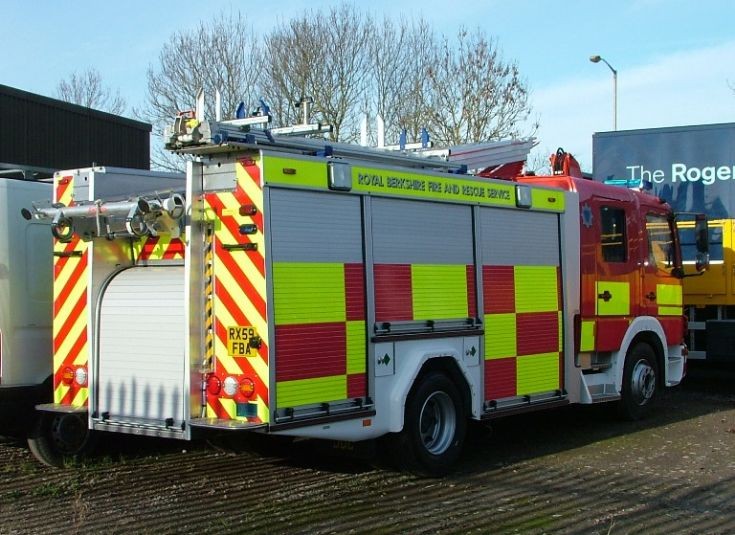
Staffordshire's recently-purchased first-away pumps have a huge equipment pod in the main ladder gantry instead of a 135 ladder. The biggest ladder they carry is the two-section job usually found on a water tender. But, instead, it's carried on the side gantry.
So the busy city station of Longton has two pumps - neither of which carry a 135 ladder.
Added by Yelp Bullhorn on 09 February 2017.
So the busy city station of Longton has two pumps - neither of which carry a 135 ladder.
Added by Yelp Bullhorn on 09 February 2017.
I take your point about the different prevalent building heights in other cities. BUT - When I lived in London in the 1970s LFB operated 28 100 foot TLs.
The aerial fleet has been halved since then, but the buildings have not become any lower!
And its not only a London problem: many UK fire authorities have reduced their ladder/tower/platform numbers. In some smaller towns, the nearest aerial is so far away that it hardly qualifies as a first response appliance.
Added by Rob Johnson on 10 February 2017.
The aerial fleet has been halved since then, but the buildings have not become any lower!
And its not only a London problem: many UK fire authorities have reduced their ladder/tower/platform numbers. In some smaller towns, the nearest aerial is so far away that it hardly qualifies as a first response appliance.
Added by Rob Johnson on 10 February 2017.
Yelp - it all reflects the fact that more and more different items are increasingly needed to be carried on first responding pumps. This is why our friends in many countries have developed ways to maximise the capacity of the bodywork, including roof stowage.
Even in countries like France and the US, where we have tended up to now to have only separate dedicated rescue units, fire services are now buying combination rescue pumpers, and often adding all sorts of extra items for flood control, hazmat and other special service calls, not to mention usually having extensive medical kit on board, too.
One solution - seen in Germany - is to equip the truck with a front-mounted pump, and have a number of different large slide-in containers which can be installed at the back, depending on the nature of the call (fire, rescue, medical, flood, hazmat, etc).
The idea of a sliding roof container is similar, just as long as the loading is not so heavy that it interferes with handling. Some European pumpers have a lot of stuff on the roof, which can look pretty precarious!
Add a heavy roof load to a 4X4, like a Unimog - and you have a "flipping" problem...
Added by Rob Johnson on 10 February 2017.
Even in countries like France and the US, where we have tended up to now to have only separate dedicated rescue units, fire services are now buying combination rescue pumpers, and often adding all sorts of extra items for flood control, hazmat and other special service calls, not to mention usually having extensive medical kit on board, too.
One solution - seen in Germany - is to equip the truck with a front-mounted pump, and have a number of different large slide-in containers which can be installed at the back, depending on the nature of the call (fire, rescue, medical, flood, hazmat, etc).
The idea of a sliding roof container is similar, just as long as the loading is not so heavy that it interferes with handling. Some European pumpers have a lot of stuff on the roof, which can look pretty precarious!
Add a heavy roof load to a 4X4, like a Unimog - and you have a "flipping" problem...
Added by Rob Johnson on 10 February 2017.
Ask a London fire officer , I did , aerials are seldom used and there is no point in investing half a million on a single extra aerial never mind ten if it doesn't get used , another thing is the number of domestics are down by a third in the last ten years due to education/smoke alarm figment by fire service personnel being a huge factor , what happens in other countries is really of no consequence or relevant to UK needs , the use of carps thankfully seems to have died a death and Scotland for instance is investing heavily in aerial appliances to replace aforementioned carps with deliveries from Rosenberg already commenced with up to fifteen on order and a mixture of alps and t/l so times are changing but will never replicate other countries
Added by Alan Ramsay on 14 February 2017.
Added by Alan Ramsay on 14 February 2017.
The question is - are they seldom used because they are seldom needed, or is it because they are so few and so widely dispersed that they are no longer very useful in terms of being able to get to an incident in time to be effectively utilized?
Added by Rob Johnson on 15 February 2017.
Added by Rob Johnson on 15 February 2017.
Alan - in your contribution you mentioned that the 13.5 meter ladder was a problem mainly because it needed four people, while the pump ladder was crewed by only four in total.
Some UK brigades still require a five person crew on a WTL, which seems to be the other half of the answer.
And I believe the FBU still strongly advocates the five person staffing level.
Dallas FD did a very exhaustive field study several years ago, running pumps, ladder trucks and rescues for several months with four, five and six man crews.
They concluded that the sixth member did not add very much to the effectiveness of the company, but reducing to four was very problematic.
In particular - ladder operation aside - it precluded a BA team getting inside until the arrival of a second unit, based on the "two in, two out" BA protocol.
Most big city departments here operate with five person crews, as they do in Japan, and in most European countries the norm is always five, and often six.
Australia is the only country I know of which operates routinely with four person crews, although of course some of our smaller and less affluent US departments have ridiculously low manning levels.
Added by Rob Johnson on 16 February 2017.
Some UK brigades still require a five person crew on a WTL, which seems to be the other half of the answer.
And I believe the FBU still strongly advocates the five person staffing level.
Dallas FD did a very exhaustive field study several years ago, running pumps, ladder trucks and rescues for several months with four, five and six man crews.
They concluded that the sixth member did not add very much to the effectiveness of the company, but reducing to four was very problematic.
In particular - ladder operation aside - it precluded a BA team getting inside until the arrival of a second unit, based on the "two in, two out" BA protocol.
Most big city departments here operate with five person crews, as they do in Japan, and in most European countries the norm is always five, and often six.
Australia is the only country I know of which operates routinely with four person crews, although of course some of our smaller and less affluent US departments have ridiculously low manning levels.
Added by Rob Johnson on 16 February 2017.
Hi, we run with five on first assuming nobody is off and four on second, seems fine but one us the driver and pump operator and sometime radio messenger so count him out, then there is the gaffer who is doing his risk assessment and planning the job so that leaves three and normally unless anyone requires rescue from height two are in ba and one is controlling them so its the second crew that deals with any ladder needs , as I say ladders unless a snatch is required are not top priority.
Added by Alan Ramsay on 22 February 2017.
Added by Alan Ramsay on 22 February 2017.
Alan:
In the US most departments do not permit BA wearers into any structure except in pairs and until and unless the same number of personnel are masked up and available outside to go in if needed, in case the wearers inside get into any kind of trouble.
This is often referred to in the service as the "two in, two out rule".
Is the UK SOP different?
Added by Rob Johnson on 23 February 2017.
In the US most departments do not permit BA wearers into any structure except in pairs and until and unless the same number of personnel are masked up and available outside to go in if needed, in case the wearers inside get into any kind of trouble.
This is often referred to in the service as the "two in, two out rule".
Is the UK SOP different?
Added by Rob Johnson on 23 February 2017.
no it isnt , deployment will only commence when suitable resources are in place , my point is ladders are not a first on the list of things to do unless there is a snatch required , a building normally has a pda of at least two pumps in any case , the next pump crew will give the ability to deal with a ladder and emergency ba (driver and gaffer will be spare), anything else will be in either a make up or pda
Added by Alan Ramsay on 27 February 2017.
Added by Alan Ramsay on 27 February 2017.
Mercedes-Benz


Added by Calvin Fox on 30 December 2009.