
Upload a Picture
About this Site | Links | Random Pic | Advanced Search
Home | Latest Additions | Contributors
| Visitors
Fire Engine Photos
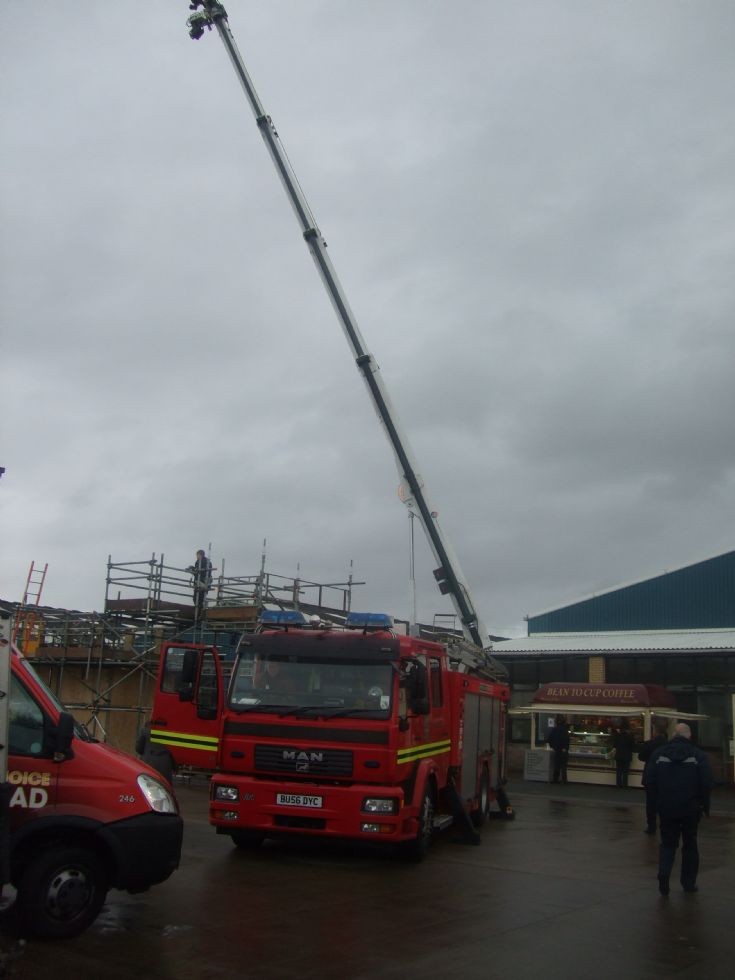
MAN Hydraulic Tower Unit
BU56DYC is a MAN Hydraulic Water Tower/Combined Rescue Pump operated by West Midlands Fire & Rescue Service. Seen at the Emergency services show at Stoneleigh November 2009
The tower is remotely operated and is fitted with two monitors, it required a High Volume Pump to keep it supplied with water when working at full capacity.
BU56DYC is a MAN Hydraulic Water Tower/Combined Rescue Pump operated by West Midlands Fire & Rescue Service. Seen at the Emergency services show at Stoneleigh November 2009
The tower is remotely operated and is fitted with two monitors, it required a High Volume Pump to keep it supplied with water when working at full capacity.
Attempts in recent years, and indeed in times gone by, to combine appliance types, particularly height and pumping appliances, have come in for much criticism, justifiably so in many cases. What was the advantage of this appliance if it needed a separate pump to allow it to perform at its maximum? That's no different from a standard build TL, HP, or ALP where a second appliance (pump) would have to be deployed when used as a water tower? TLs, HPs and ALPs also have the big plus of having a rescue capability, this appliance lacks that capability. Was the big plus its two monitors but generally if a job is that big that it requires two monitors, they will be placed well apart or on opposite sides to surround the incident? The jet reaction from dual monitors would have been interesting to calculate? Seems absolutely pointless ... or am I missing something?
Added by Keith Richardson on 06 September 2018.
Added by Keith Richardson on 06 September 2018.
West Midlands disposed of this example. But we have the success of the Rosenbauer Stinger at Lancashire and the fact they have ordered a second one - though the first Stinger was a cancelled order from Manchester leased by Lancs originally as a trial. See my article in a recent addition of Fire Cover no 217.
Added by Petros on 08 September 2018.
Added by Petros on 08 September 2018.
Stinger, in effect a Mk4 Scoosher is apparently very good when it is on the run but is a touch tempremental.
Added by Neal Glover on 11 September 2018.
Added by Neal Glover on 11 September 2018.
The Stinger's big plus is the piercing nozzle on the boom. This was originally developed for aircraft fires and quite a few airports now have crash trucks with Stinger booms.
Developing a version for municipal use was motivated by the increasing problem of tackling fires in modern windowless steel industrial structures - which have become much more common.
These are often very large and can pose a major fire risk. Roofs may be difficult to access and structurally rather feeble, and chopping holes in the walls can be very time consuming.
The Stinger offers a higher volume - and greater reach than a Fognail or Cold Cutter - and has an infrared camera as well as a nozzle which I believe can deliver over 3000 LPM if necessary.
It remains to be seen whether these will be a successful innovation, but in theory they should be a useful tool - and they have certainly been enthusiastically adopted by airports and air forces in many countries. Whether its sting can successfully penetrate other types of structures' walls or roofs seems to still be a bit of an unresolved question, though.
To Keith's point, these do have a built in 4, 500 LPM pump, and can operate independently, as well as functioning as a normal pumper too.
Added by Rob Johnson on 12 September 2018.
Developing a version for municipal use was motivated by the increasing problem of tackling fires in modern windowless steel industrial structures - which have become much more common.
These are often very large and can pose a major fire risk. Roofs may be difficult to access and structurally rather feeble, and chopping holes in the walls can be very time consuming.
The Stinger offers a higher volume - and greater reach than a Fognail or Cold Cutter - and has an infrared camera as well as a nozzle which I believe can deliver over 3000 LPM if necessary.
It remains to be seen whether these will be a successful innovation, but in theory they should be a useful tool - and they have certainly been enthusiastically adopted by airports and air forces in many countries. Whether its sting can successfully penetrate other types of structures' walls or roofs seems to still be a bit of an unresolved question, though.
To Keith's point, these do have a built in 4, 500 LPM pump, and can operate independently, as well as functioning as a normal pumper too.
Added by Rob Johnson on 12 September 2018.
Comment removed at request of Commentor
The scoosher had the spike but I think without the holes in it. It also had a camera but I don't think thermal imaging was developed in those days. The technology may have moved on but the concept is 50 years old.
Added by Neal Glover on 13 September 2018.
Added by Neal Glover on 13 September 2018.
Andy - of course I agree, as long as the fire structure is compartmentalized and the Stinger can't for some reason penetrate the right one!
But this is exactly the reason why the Stinger is potentially useful at fires in large modern industrial steel buildings; they tend not to be chopped up into too many individual rooms and have thin walls and roofs.
But it may not a complete solution in older structures which are less open plan, especially if the construction cannot be pierced.
Its success will depend on how well it is used.
Certainly both the Fog Nail and the Cobra Cold Cutter have eliminated the need for a lot of classical inside fire attack tactics in several countries, with a much safer working environment for the responding fire crews - and the Stinger has the potential to do the same in some cases.
It fills the burning space with water spray or either class A or B foam, rather than filling it with firefighters - and 3000 LPM can deal a fatal blow to quite a large body of fire!
Added by Rob Johnson on 14 September 2018.
But this is exactly the reason why the Stinger is potentially useful at fires in large modern industrial steel buildings; they tend not to be chopped up into too many individual rooms and have thin walls and roofs.
But it may not a complete solution in older structures which are less open plan, especially if the construction cannot be pierced.
Its success will depend on how well it is used.
Certainly both the Fog Nail and the Cobra Cold Cutter have eliminated the need for a lot of classical inside fire attack tactics in several countries, with a much safer working environment for the responding fire crews - and the Stinger has the potential to do the same in some cases.
It fills the burning space with water spray or either class A or B foam, rather than filling it with firefighters - and 3000 LPM can deal a fatal blow to quite a large body of fire!
Added by Rob Johnson on 14 September 2018.
Comment removed at request of Commentor
Local fire service had a big problem recently with a big fire in a garden centre which was a low 'corrugated metal' type building which covered a very large area and had no windows. It was hard to get to the seat of the fire.
Added by Craigw on 29 September 2018.
Added by Craigw on 29 September 2018.
These devices are in widespread use not only in their native Scandinavia but in many other countries too.
Although they are not a universal panacea to solving the problem of fires in confined or inaccessible portions of buildings, they have proven effective in many situations and are far from being "gimmicks".
Of course, it is no secret that some firefighting innovations through the centuries have indeed been proven to be ineffective or even dangerous.
But the Stinger, the Fognail and the Cold Cutter all have a contribution to make in situations where more conventional old school approaches and tactics may not be as effective. No-body has suggested they are the only way to tackle such incidents, but their use in many countries does illustrate that they have a useful role when applied properly,
Added by Rob Johnson on 28 October 2019.
Although they are not a universal panacea to solving the problem of fires in confined or inaccessible portions of buildings, they have proven effective in many situations and are far from being "gimmicks".
Of course, it is no secret that some firefighting innovations through the centuries have indeed been proven to be ineffective or even dangerous.
But the Stinger, the Fognail and the Cold Cutter all have a contribution to make in situations where more conventional old school approaches and tactics may not be as effective. No-body has suggested they are the only way to tackle such incidents, but their use in many countries does illustrate that they have a useful role when applied properly,
Added by Rob Johnson on 28 October 2019.
MAN


Added by Peter Williams on 02 January 2011.