
Upload a Picture
About this Site | Links | Random Pic | Advanced Search
Home | Latest Additions | Contributors
| Visitors
Fire Engine Photos
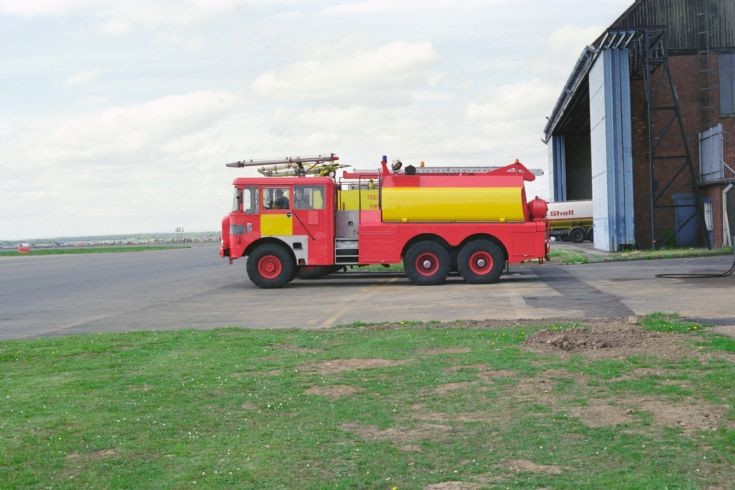
it's an ex BAA mk 2 major 1800 gallons water capacity. The monitor operator rode in the rear of the cab and was strait onto the platform when required .it has a safety rail that the operator clipped his harness too and could ride the platform on the move if necessary.I think you can see the monitor operator in the photo.
Added by A.j.alexander on 08 October 2009.
Added by A.j.alexander on 08 October 2009.
I think that was a Nubian Major which was on loan to Teesside whilst their own machine was under refurbed. I believe it was a former BAA appliance.
John...as far as I remember, there was a sliding door at the rear of the crew cab.
Added by Barrie Green on 08 October 2009.
John...as far as I remember, there was a sliding door at the rear of the crew cab.
Added by Barrie Green on 08 October 2009.
The school one wasn't Barrie as it drew very disparaging comments from the ex RAF and Navy men. I remember seeing some with a small jackknife door in the rear bulkhead though. Blackpool and Rhys had similar models and Glamorgan CC had one.
Added by John Stott on 09 October 2009.
Added by John Stott on 09 October 2009.
You are right Guys it was a BAA vehicle from Heathrow. They were decommisioned by BAA in favour of Javelins (big mistake)
Added by Chucklebus on 04 February 2010.
Added by Chucklebus on 04 February 2010.
I can't believe I have seen this. I am certain that it's the one that I helped to refurbish when I was an apprentice at Hargreaves in the mid eighties. It took a lot of work as stripped back to chassis and replaced all the rotten metal that has eroded from the foam and water. Good times.
Ed: anybody know the registration mark?
Added by Denis ford on 19 January 2024.
Ed: anybody know the registration mark?
Added by Denis ford on 19 January 2024.
Also bearing in mind that the Chubb Fire Pathfinder in operation predates that photo by almost 20 years. It suggests an unbelievable contrast in the thinking of manufacturers v operators.
Added by Geoff on 20 January 2024.
Added by Geoff on 20 January 2024.
Getting the users to be involved with design and ergonomics is a really very necessary part of the process. I recently saw a video of West Metro FD's new Hazmat truck. This was designed and built by a local firm over a two year period, with weekly meetings and reviews between the designers, builders and WMFD hazmat and special operations personnel, and an almost continuous review of every step by everyone concerned.
It especially addressed two concerns:
First, how to begin to plan the hazmat intervention while still en route to the incident, rather than starting to address the situation only after arriving on scene. This was solved by having two crew members at their computers inside the command module en route, gathering information and identifying action plans during the run.
Second, how to anticipate the growth and increasing variety of hazmat incidents over the expected life of the new truck, projecting out the historic doubling of the monthly rate of incidents over the past two decades. This was solved by designing highly flexible storage, so that - for example - items ilke the fire blankets used on ekectric vehicle fires could be easily stored and accessed.
The service pointed out that new technology has created a vast array of new hazmat situations, not least associated with lithium ion batteries in household appliances, electric bikes and of course electric vehicles.
Added by Rob Johnson on 20 January 2024.
Rob the reference to the choice between Pathfinder v Nubian Manor being there almost 20 years before the latter still being in service and the fact that the Grenfell fiasco could have been magnified by a massive factor in the case of an aircraft incident combined with a multiple tower block estate suggests tombstone economics being at work.
Added by Geoff on 20 January 2024.
Added by Geoff on 20 January 2024.
Great example of the fact that old trucks are not designed to handle new dangers. Something about old dogs and new trucks?
Added by Rob Johnson on 21 January 2024.
Added by Rob Johnson on 21 January 2024.
Basically all the best command and control or rapid intervention in the world is no substitute for lack of tankage/pumping/arial capability/ease of use, on arrival on scene. Purchase cost generally being directly proportional with the latter. Obviously many operators/purchasers historically gambling in that regard.
Added by Geoff on 21 January 2024.
Added by Geoff on 21 January 2024.
Thornycroft


Added by John Stott on 08 October 2009.