
Upload a Picture
About this Site | Links | Random Pic | Advanced Search
Home | Latest Additions | Contributors
| Visitors
Fire Engine Photos
No: 19207 Contributor: Jacques Peter Year: 1999 Manufacturer: Mack Country: United States of America
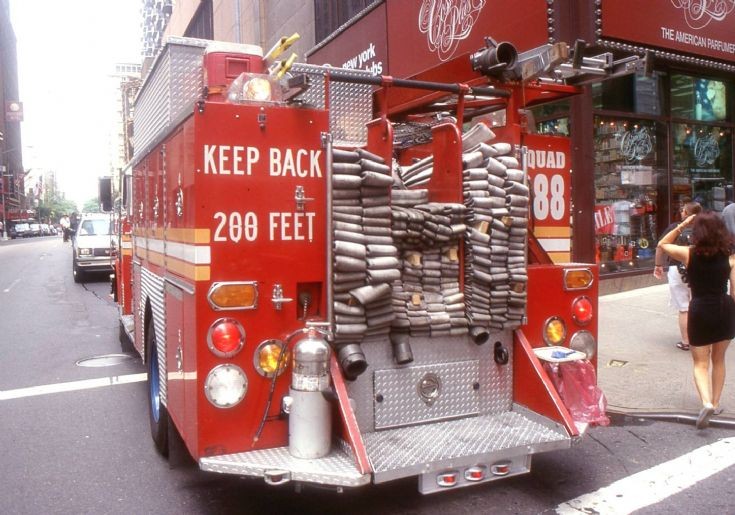
NYFD, USA - 1999 Squad 288 Mack
New York Fire Department USA
Rear view Squad 288 Mack CF Queens
July 1999 in Broadway district
Alarm for carbon monoxide in a high rise hotel
New York Fire Department USA
Rear view Squad 288 Mack CF Queens
July 1999 in Broadway district
Alarm for carbon monoxide in a high rise hotel
This picture is in the following groups
Fire Department New York, USA
Fire Department New York, USA
Now, isn't that just a well-equpped rear-end? Uh, the Fire-Truck.... I mean....what WERE you thinking ?!
Good variety of hoses in the bed.
BTW, what are the wooden wedges, that are inserted between the layers, used for ?
To mark disconnected hose-couplings ? perhaps, to carry into the building to wedge activated Fire Sprinkler Heads shut ? wedge doors open for running hose ?
Great shot.
Regards, from Canada,
Pat_R-B
Added by Pat Rivers-Bowerman on 09 September 2009.
Good variety of hoses in the bed.
BTW, what are the wooden wedges, that are inserted between the layers, used for ?
To mark disconnected hose-couplings ? perhaps, to carry into the building to wedge activated Fire Sprinkler Heads shut ? wedge doors open for running hose ?
Great shot.
Regards, from Canada,
Pat_R-B
Added by Pat Rivers-Bowerman on 09 September 2009.
Door wedges for interior fires. They are carried in the 1.75 inch and 2.5 inch hose flakes, to be close to hand if these lines are to be used on interior fires. Some German departments carry wedges on their 40mm attack hose baskets, for the same reason.
Added by Rob Johnson on 15 April 2010.
Added by Rob Johnson on 15 April 2010.
How Are these wedges held onto the hose ? If thats not a silly question...
Added by Paul.warnock on 15 April 2010.
Added by Paul.warnock on 15 April 2010.
Paul,yes thats a silly question.The wedges are not held onto the hose,they are wedged between the fold in the hose on the hose deck.A firefighter would before entering a building-crab 2/3 of these and generally place them on the outside of their helmet.They are at hand then if required to wedge doors open for the laying out of hose before it being charged with the wet stuff.
Added by Pete Matten on 16 April 2010.
Added by Pete Matten on 16 April 2010.
Thanks Pete, I knew it was silly question, I had an Idea they were wedged in. But thats what you get looking at these pictures after a few big glasses of red wines. !!!!
Added by Paul Warnock on 16 April 2010.
Added by Paul Warnock on 16 April 2010.
Perhaps this is another silly question! But why do FDNY insist on you 'keeping back 200 feet'? Does it perhaps refer to moving traffic, i.e. tailgaters? Or is it to stop vehicles parking behind the appliance thus interfering with firefighters running hose out, etc.?
(Please be gentle with me, Pete!)
Added by Yelp Bullhorn on 16 April 2010.
(Please be gentle with me, Pete!)
Added by Yelp Bullhorn on 16 April 2010.
You caught me out on that question Yelp,but its not just in New York you see this.On some American apparatus statewide, some even say 1000 feet ,especially on those long tillered aerial trucks which need a lot of space.
One thing I have noticed though during my visits to NY, traffic runs only one way, especially in the Manhattan district, and vehicles are parked both sides of the road. When an appliance (apparatus) rolls up it stops in the middle of the road, hoselines are (streched) run out and connected (same as UK) over a wide area before entering building/appartment. The term stretching a line refers really though to the paying-out from the hose deck the hose. This is often done as the apparatus nears the incident with the apparatus still moving along the street, a firefighter stands on the tailgate feeding the hose off to firefighters in the road who then connect to the hydrant.Therefore, a wide area will be needed so other vehicles are warned 'Keep Back 200 Feet'.
I'm sure this is only one of the answers, and I'm sure one of our friends across the pond will add a little bit more information to correctly answer this question fully.
OK Yelp?, I didn't say it was a silly question and unless you ask, you'll never find out.
Added by Pete Matten on 16 April 2010.
One thing I have noticed though during my visits to NY, traffic runs only one way, especially in the Manhattan district, and vehicles are parked both sides of the road. When an appliance (apparatus) rolls up it stops in the middle of the road, hoselines are (streched) run out and connected (same as UK) over a wide area before entering building/appartment. The term stretching a line refers really though to the paying-out from the hose deck the hose. This is often done as the apparatus nears the incident with the apparatus still moving along the street, a firefighter stands on the tailgate feeding the hose off to firefighters in the road who then connect to the hydrant.Therefore, a wide area will be needed so other vehicles are warned 'Keep Back 200 Feet'.
I'm sure this is only one of the answers, and I'm sure one of our friends across the pond will add a little bit more information to correctly answer this question fully.
OK Yelp?, I didn't say it was a silly question and unless you ask, you'll never find out.
Added by Pete Matten on 16 April 2010.
Many American cities have the same warning on their ambulances. I think it is more to do with the fact that fire trucks and ambulances may stop rather suddenly, and other drivers may not be paying attention, mesmerized by all the lights, sirens and air horns.
Added by Rob Johnson. on 16 April 2010.
Added by Rob Johnson. on 16 April 2010.
Thanks for the answers, guys. I assumed it was purely to stop tailgating, but now you mention how our colonial cousins run the hoses out, I should have guessed.
Added by Yelp Bullhorn on 17 April 2010.
Added by Yelp Bullhorn on 17 April 2010.
hi guys,i thought the 200 ft was a safety distance in case any one fell off in the old days of standing on the back or side of the engine
Added by Ian Mc on 18 April 2010.
Added by Ian Mc on 18 April 2010.
Paul W. Thanks for "Taking The Point" and boldly asking away; me and a whole bunch of other guys here didn't know either.....
The "Keep Back xxx Feet/Metres" on the back of our rigs is, as 'a standard fitting', as the Emergency Lights; and I have not thought much about them, other than to wonder, how the different lengths indicated, were chosen.
With adoption (partially!) of The Metric System in Canada; it is also a great indicator for The Fire Engine Fan, initially coming on a Fire-Scene....
The older(more interesting - UK, think 'Dennis, Bedford'etc) rigs would still have theirs in "Feet", from the rear...while the newer ('Euro-Toasters' - Scania, Volvo perhaps) would be in "Metres"; so you would know which ones to go look at first......
Another reason, to encourage 'Rear View' Photos on the Marcels' Web-Site here !!
Added by Pat Rivers-Bowerman on 19 April 2010.
The "Keep Back xxx Feet/Metres" on the back of our rigs is, as 'a standard fitting', as the Emergency Lights; and I have not thought much about them, other than to wonder, how the different lengths indicated, were chosen.
With adoption (partially!) of The Metric System in Canada; it is also a great indicator for The Fire Engine Fan, initially coming on a Fire-Scene....
The older(more interesting - UK, think 'Dennis, Bedford'etc) rigs would still have theirs in "Feet", from the rear...while the newer ('Euro-Toasters' - Scania, Volvo perhaps) would be in "Metres"; so you would know which ones to go look at first......
Another reason, to encourage 'Rear View' Photos on the Marcels' Web-Site here !!
Added by Pat Rivers-Bowerman on 19 April 2010.
Well that's cleared up a very old mystery for me! I always wondered why the Fire Fighters in the Backdraft movies had wedges in their helmets!
Added by Andy Bain on 20 April 2010.
Added by Andy Bain on 20 April 2010.
Mack


Added by Pete Matten on 08 September 2009.