
Upload a Picture
About this Site | Links | Random Pic | Advanced Search
Home | Latest Additions | Contributors
| Visitors
Fire Engine Photos
Hey John, I have 2 more questions. You refer to the "tubing", what is that? The other is, out in the fire district how are the fire hydrants/plugs(?) placed. Are they like the US version, a metal housing sticking above ground or underneath. And how far apart are they (in the US anywhere from 160 to 300 meters apart). Thanks.
Added by David Lampp on 13 August 2009.
Added by David Lampp on 13 August 2009.
dave in the uk tubing is firefighters slag for hose.the other is where you connect the hose from the hydrant to fill the tank. Our hydrants are underground and we use a standpipe and t-key. In this country the hydrants are just placed where there is a main water pipe which could be from a 60inch main to 100+.
Added by Tg on 13 August 2009.
Added by Tg on 13 August 2009.
Hi David, we call the hosereel "tubing". The hydrants are underground, covered by a cast plate and a standpipe is screwed on then a key turns on the valve. As for distance apart, depends on the area and where the Victorians put them! Many more in towns obviously, usually about a hundred yards. Where I live in the country about half a mile with a 3 inch main and about 30psi.
Added by John Stott on 13 August 2009.
Added by John Stott on 13 August 2009.
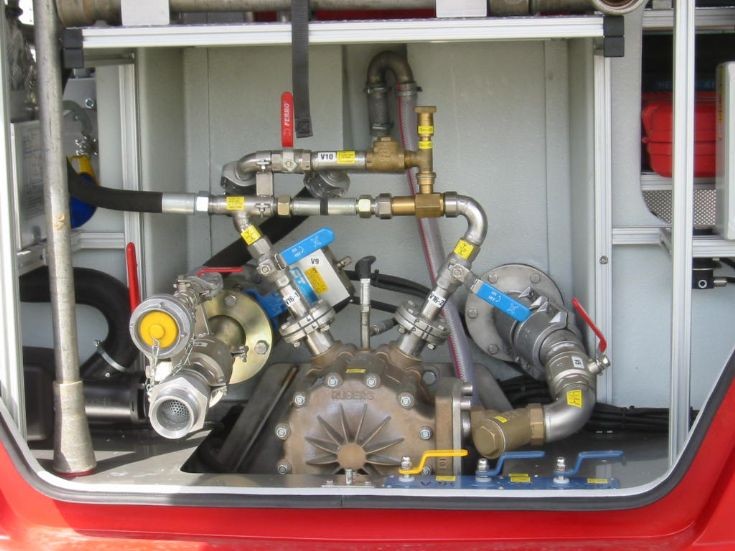
David I think the two valves you are referring to are tank filler inlets. The lower one is for the water tank with a strainer inside to stop unwanted objects getting in the tank, and the top pipe is for foam compound. This vehicle has a 1000 litre water tank and a 100 litre foam compound tank. The fire hydrants in the UK are all underground and are accessed from a metal cover/lid and a upright pipe called a "stand pipe" is screwed on to the water pipe and the another tool called a "key and bar" are used to open and close the hydrant valve. If you have a look at picture 18588 you can see this equipment, on the shelf above the pump with a red box behind is the "Standpipe" and to the left of the pump is a thin tube stood upright this is the "Key and Bar". Hydrants vary in different places depending if they are in the Towns and Cities or in Rural areas. Some hydrants in Rural areas can be miles apart in some locations. In Towns and Cities they don't seem to at any set distances apart usually, on junctions of street and then spread out a long the street or road. Hope this helps. Paul.
Added by Paul Warnock on 13 August 2009.
Added by Paul Warnock on 13 August 2009.
'tubing' is and old London Fire brigade term for a hose reel or 'first aid reel' a small diameter reel of hard rubber hose for smaller fires.
British fire hydrants are below ground in a pit covered by a metal lid. A alloy standpipe is screwed into the hydrant which brings the water above ground and into the hose.
Hydrants are reasonably plentifully in the city areas but not so much in the rural area. Knowing the water supplies is essential for country fire crews
Hope this helps David
Added by Barrie Green on 13 August 2009.
British fire hydrants are below ground in a pit covered by a metal lid. A alloy standpipe is screwed into the hydrant which brings the water above ground and into the hose.
Hydrants are reasonably plentifully in the city areas but not so much in the rural area. Knowing the water supplies is essential for country fire crews
Hope this helps David
Added by Barrie Green on 13 August 2009.
Forgot to mention David, on older hydrants the valve is protected by what we call a "false spindle", this fits over the valve and protects it from damage by the turnkey.
Added by John Stott on 14 August 2009.
Added by John Stott on 14 August 2009.
Bob
judging by the number of fittings/clips and compression joints on this pump it looks like its made either by 'Heath and Robinson' or 'WE Bodgitt and Scarper'?
Added by Rick Loudon on 13 December 2010.
judging by the number of fittings/clips and compression joints on this pump it looks like its made either by 'Heath and Robinson' or 'WE Bodgitt and Scarper'?
Added by Rick Loudon on 13 December 2010.
OK...thanks guys....so one of the 3 is a possibility...I initially thought Ruberg due to shape..but im unable to satisfactorily make out the name on the casing...
Added by Bob M on 15 December 2010.
Added by Bob M on 15 December 2010.
Bob
I apologise, my suggestions were 'tongue in cheek' and meant as a joke -the whole contraption looks like its set to fail at every connection ! but then that's the 'modern day fire service' for you - why they don't stick with what's proven I don't know ? - BTW you're right - it appears to be 'Ruberg' on the pump casing - whoever they are ?
Added by Rick Loudon on 15 December 2010.
I apologise, my suggestions were 'tongue in cheek' and meant as a joke -the whole contraption looks like its set to fail at every connection ! but then that's the 'modern day fire service' for you - why they don't stick with what's proven I don't know ? - BTW you're right - it appears to be 'Ruberg' on the pump casing - whoever they are ?
Added by Rick Loudon on 15 December 2010.
OK..for those of you interested...have a look at the W Ruberg AB website...
Added by Bob M on 16 December 2010.
Added by Bob M on 16 December 2010.
Renault


Thanks.
Added by David on 05 August 2009.