
Upload a Picture
About this Site | Links | Random Pic | Advanced Search
Home | Latest Additions | Contributors
| Visitors
Fire Engine Photos
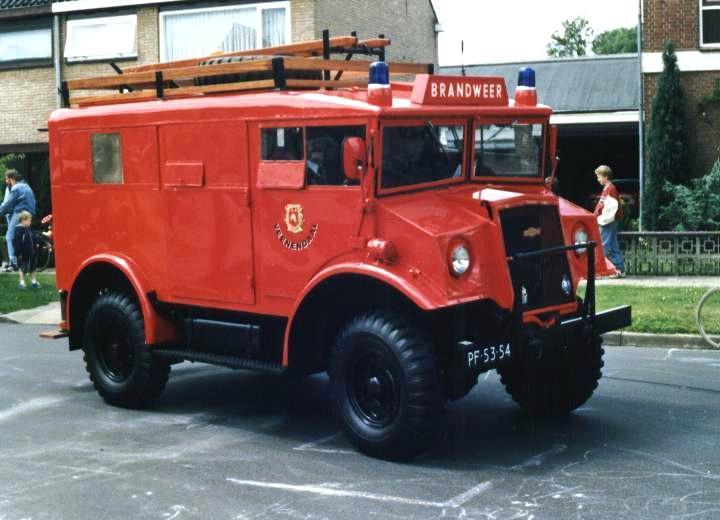
No: 15496 Contributor: Frank van der Weerden Year: 1991 Manufacturer: Chevrolet Country: The Netherlands
Yes, Chris hence the "dump truck" name. There was a purplus of military chassis after the war and a shortage of trucks for fire engines, so the easiest and cheapiest way to buy them and let them rebuilt as a fire engine
Added by Fire995 on 25 February 2009.
Added by Fire995 on 25 February 2009.
Thanks for posting these classic WW2 trucks, Frank. I didn't know they were called 'dump trucks' in your country, but I assume it comes from the fact that they were left in various countries when US forces were withdrawn. The US government deemed it unwise to bring these (surviving) vehicles back as civilian truck manufacturers did not want a glut of used vehicles on the market--their lobby in Congress got their way. Too, it would have been too costly to ship them back. This particular unit, a CMP- Canadian Military Pattern Chevrolet, appears to have been a Radio-Communications unit; both Chevrolet and Ford built CMP trucks, and while most of those that wound up in Europe were built in Canada, CMP military trucks were built in Australia, India, and South Africa for Allied forces. The Ford-built trucks seem to be in the minority of survivors that still run some 69 years later. Thanks again
Added by Bob Graham on 25 February 2009.
Added by Bob Graham on 25 February 2009.
Thanks, Bob G., for the information on this Canadian Military Pattern (CMP) truck. Over 400, 000 were produced for World War 2.
This one was likely 1941 or later, as it has the Type 13 forward-tilting wind-shield. I agree that it has the 'box-body' for a Radio-Communications unit; the Field Artillery Tractor (F.A.T.) had a much more angular body....it towed a Limber and the legendary 25-pounder Field Gun (I had the Dinky Toy set as a kid).
These trucks were built to British Military specification, hence "Right-Hand Drive" and smaller size; for shipping to, and also assembly elsewhere, all round the globe.
Other than the Ford and Chevrolet Truck Plants, in Canada building them...they were not USA vehicles. USA produced its own range of military vehicles.
Great to see this CMP variant safely in preservation.
Regards, from Canada,
Pat_R-B
Added by Pat Rivers-Bowerman on 25 August 2010.
This one was likely 1941 or later, as it has the Type 13 forward-tilting wind-shield. I agree that it has the 'box-body' for a Radio-Communications unit; the Field Artillery Tractor (F.A.T.) had a much more angular body....it towed a Limber and the legendary 25-pounder Field Gun (I had the Dinky Toy set as a kid).
These trucks were built to British Military specification, hence "Right-Hand Drive" and smaller size; for shipping to, and also assembly elsewhere, all round the globe.
Other than the Ford and Chevrolet Truck Plants, in Canada building them...they were not USA vehicles. USA produced its own range of military vehicles.
Great to see this CMP variant safely in preservation.
Regards, from Canada,
Pat_R-B
Added by Pat Rivers-Bowerman on 25 August 2010.
Fire services in several countries - especially France - deployed hundreds of rebodied ex US Army GMC 6X6 trucks after the end of WWII.
Although used in different roles, the vast majority were converted in to brush pumpers. They usually had a 3000 liter tank, a portable pump around 1000 LPM capacity, and a first aid hose reel. A few had quite elaborate custom bodywork including a four door crew cab, but most were pretty basic - including both enclosed and open cab versions.
They usually retained the standard front winch, but some had a fixed front mounted pump instead.
Added by Rob Johnson on 21 September 2018.
Although used in different roles, the vast majority were converted in to brush pumpers. They usually had a 3000 liter tank, a portable pump around 1000 LPM capacity, and a first aid hose reel. A few had quite elaborate custom bodywork including a four door crew cab, but most were pretty basic - including both enclosed and open cab versions.
They usually retained the standard front winch, but some had a fixed front mounted pump instead.
Added by Rob Johnson on 21 September 2018.
Chevrolet


Added by Chris Hall Teesside UK. on 25 February 2009.