
Upload a Picture
About this Site | Links | Random Pic | Advanced Search
Home | Latest Additions | Contributors
| Visitors
Fire Engine Photos
No: 12133 Contributor: Lou Angeli Year: 1928 Manufacturer: American LaFrance Country: United States of America
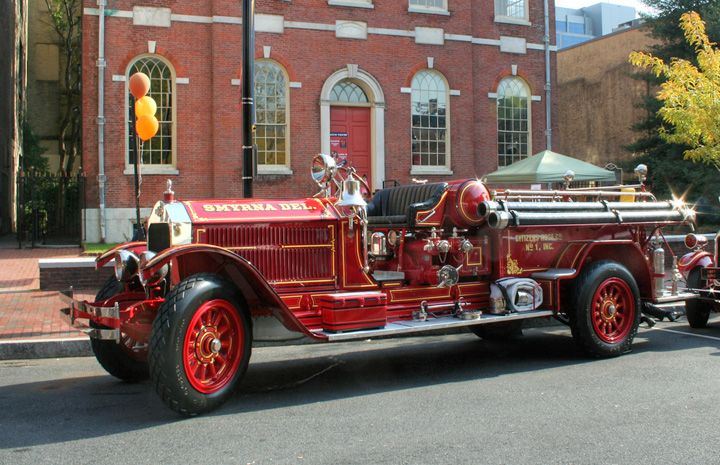
1928 American LaFrance
This ALF Type 145 boasts a 1,000 gpm rotary gear 2 stage pump, an 80 gallon water tank, and a chain driven 6 cylinder T-head motor. It remains on the roster of the Citizens' Hose Company of Smyrna, Delaware, a department which began operations just after the American Civil War. It was originally delivered on September 6, 1928 at a cost of $10,996.
This ALF Type 145 boasts a 1,000 gpm rotary gear 2 stage pump, an 80 gallon water tank, and a chain driven 6 cylinder T-head motor. It remains on the roster of the Citizens' Hose Company of Smyrna, Delaware, a department which began operations just after the American Civil War. It was originally delivered on September 6, 1928 at a cost of $10,996.
The fire engines of the 1920's were built for reliability, so manufacturers used technology that was tried and true -- like the chain drive.
At this point in American Firefighting History, the "Engine Company" was actually composed of two apparatus -- the Chemical Hose Wagon, whose crew made the initial attack using what was essentially a huge soda-acid extinguisher.
Upon their arrival, the wagon crew would also drop a 2.5 inch hose from the hydrant to the fire scene...also known as "laying in." The second machine of the 2-piece engine company was a pumper, like the one pictured here. It's crew would connect to the hydrant using the hard sleeve (in most cases), attach which had been dropped by the hosewagon to a discharge, then begin pumping that "supply line."
Back at the fire structure, the wagon had a simple manifold system (piping, valves and gates) that would allow a 2nd hoseteam to back up the wagon crew with a conventional water line connected to the manifold.
In a single generation, most chemical wagons were replaced with a class-A pumpers, however the two piece system remained a major part of American firefighting tactics until the introduction of 5" supply line, the first of which was delivered from the UK to the Kennett Fire Company in Pennsylvania. Manufactured by Angus, the hose was black in color and known as Black Angus. Beginning in the late 1970's, departments began to phase out a dedicated hydrant pumper, as the 5" HiVol supplied much more water than the pumper could deliver under pressure.
I have some archival motion picture footage which clearly demonstrates what I've just described. It was filmed by the Los Angeles City Fire Department, which is one of the few remaining US fire-rescue agencies that still operate 2-piece engine companies. Please check this page as I will post the video link here in a few days.
Added by Lou Angeli on 03 November 2008.
At this point in American Firefighting History, the "Engine Company" was actually composed of two apparatus -- the Chemical Hose Wagon, whose crew made the initial attack using what was essentially a huge soda-acid extinguisher.
Upon their arrival, the wagon crew would also drop a 2.5 inch hose from the hydrant to the fire scene...also known as "laying in." The second machine of the 2-piece engine company was a pumper, like the one pictured here. It's crew would connect to the hydrant using the hard sleeve (in most cases), attach which had been dropped by the hosewagon to a discharge, then begin pumping that "supply line."
Back at the fire structure, the wagon had a simple manifold system (piping, valves and gates) that would allow a 2nd hoseteam to back up the wagon crew with a conventional water line connected to the manifold.
In a single generation, most chemical wagons were replaced with a class-A pumpers, however the two piece system remained a major part of American firefighting tactics until the introduction of 5" supply line, the first of which was delivered from the UK to the Kennett Fire Company in Pennsylvania. Manufactured by Angus, the hose was black in color and known as Black Angus. Beginning in the late 1970's, departments began to phase out a dedicated hydrant pumper, as the 5" HiVol supplied much more water than the pumper could deliver under pressure.
I have some archival motion picture footage which clearly demonstrates what I've just described. It was filmed by the Los Angeles City Fire Department, which is one of the few remaining US fire-rescue agencies that still operate 2-piece engine companies. Please check this page as I will post the video link here in a few days.
Added by Lou Angeli on 03 November 2008.
To answer your question about the preservation of the American LaFrance, I can provide first-hand commentary. In the mid 1980's, I was given the assignment to photograph American LaFrance's celebration of its 150th anniversary with a parade, rally and muster in Elmira, NY. Now, for those of you who aren't familiar with US geography, Elmira is in the middle of nowhere, but on that day tens of thousands of visitors and firefighters came to celebrate. The ensuing parade lasted 5 hours, playing host to several hundred American LaFrance restorations, including the company's first apparatus.
Perhaps my American colleagues could help me verify an accurate total, but it seems to me that there are at least 1, 000 restored American LaFrance engines and ladders owned by individuals and fire departments in the US and Canada.
Added by Lou Angeli on 03 November 2008.
Perhaps my American colleagues could help me verify an accurate total, but it seems to me that there are at least 1, 000 restored American LaFrance engines and ladders owned by individuals and fire departments in the US and Canada.
Added by Lou Angeli on 03 November 2008.
Lou;
Thanks for the excellent description of the Chemical Engines' and the Hose Wagons' operations.
I did wonder what the Chemical Wagon did, after discharging its' tank; and why some City FD's were still running Hose Wagons.....
This Parade Engine is 80 years old - and with the same FD - talk about "value for money" !
And in Mint Condition - a real credit to those members who have restored and looked after her.
For British readers: Ahrens-Fox "The Rolls-Royce of Fire Engines", during this period, also offered their legendary Pumpers in either Chain Drive, or, Propellor Shaft Drive. See Picture # 191 in the Ahrens-Fox "Built by" list..
And, looks like, still, Right-Hand Drive here (-;]
Regards, from Canada,
Pat_R-B
Added by Pat Rivers-Bowerman on 03 November 2008.
Thanks for the excellent description of the Chemical Engines' and the Hose Wagons' operations.
I did wonder what the Chemical Wagon did, after discharging its' tank; and why some City FD's were still running Hose Wagons.....
This Parade Engine is 80 years old - and with the same FD - talk about "value for money" !
And in Mint Condition - a real credit to those members who have restored and looked after her.
For British readers: Ahrens-Fox "The Rolls-Royce of Fire Engines", during this period, also offered their legendary Pumpers in either Chain Drive, or, Propellor Shaft Drive. See Picture # 191 in the Ahrens-Fox "Built by" list..
And, looks like, still, Right-Hand Drive here (-;]
Regards, from Canada,
Pat_R-B
Added by Pat Rivers-Bowerman on 03 November 2008.
Considering that motorization of fire apparatus began approximately in 1906, I think ALF did an absolutely magnificent job with this in 1928.
Added by Dan E. Boyd on 05 March 2010.
Added by Dan E. Boyd on 05 March 2010.
I was looking for some information on our 1928 chemical truck that I restored. I need info on the chemical tanks/// I would greatly appreciate any info. Waddington Fire bought it new in 1928.
Added by Michael Badlam on 22 August 2010.
Added by Michael Badlam on 22 August 2010.
American LaFrance


Are there many of these in preservation and what would their value be?
Added by White and Poppe on 02 November 2008.