
Upload a Picture
About this Site | Links | Random Pic | Advanced Search
Home | Latest Additions | Contributors
| Visitors
Fire Engine Photos
Ps if you don't catch it, in the leyland "made by" group - picture 10682 is stephen's front view of this little honey.
regards, from canada,
pat_r-b
Added by Pat Rivers-Bowerman on 07 October 2008.
regards, from canada,
pat_r-b
Added by Pat Rivers-Bowerman on 07 October 2008.
Pat, I use to drill on the wheeled escape back in the sixties in Auckland NZ. They could only be carried on appliances that were fitted out for the purpose, in our case the Dennis F12. It took four men to move the beast, one on each cart wheel and two at the carriage rear to steady and push.
To get it off the machine the ladder release was actioned and the two guys at the rear had to physically jump up and hang off the rear carriage and bear down with all their weight as it balanced beautifully in the ladder cradle. As the head went upward away from the roof of the appliance, the wheels and ladder came down onto the roadway. The guys on the wheels would roll it back to clear the machine, then it was a team effort to move it forward to the fireground location. You didn't want to be anywhere near a slope or hill or it could get away from you real quick. The two little metal wheels at the foot of the ladder actually ran along the pavement, and it was surprising how well-balanced and agile the whole contraption went! There were two chocks for each cart wheel once positioned to stop it from running away.
Then the two guys on the back would wind like hell on the handles to extend the sections, three in all I think from memory, 50 foot in total. We use to chuck her up to the roof of the engine room at Pitt Street Headquarters and then run up and carry some poor bugger down in a 'fireman's lift.' It was no fun being carried, especially when the bloke doing the carrying had to climb up on the parapet and then try and mount the head of the ladder, while you were slipping off his shoulders and hanging onto his tunic or trousers for dear life!
Another good trick the officers liked to have us do was chuck her up full extension against the hose tower, (purpose built 100 foot concrete building that was fun to run up and down in full BA), then by means of the hook ladder, make your way up a couple more floors vide the exterior window sills with a 2½ inch canvas hose and show a bit of water. Amazing what you can do when you're young aye?
I don't recall ever seeing the wheeled escape in use at a fire ground, but no doubt they had a lot of use in the earlier years. They were actually a very stable platform to work from, you didn't have to chuck them against a building to get to work with water, but you had to be damn careful with a charged hose if you were going to do that.
I remember every time you drilled on the b'steds you ended up with skin off! No one ever came away unscaved.
Pat, there is a link that will show you an escape in action by Mike Barnard of West Sussex Fire & Rescue Service:
www.wessexfireservices.co.uk/42586.html?*session*id*key*=*session*id*val*
Added by Pavel on 09 October 2008.
To get it off the machine the ladder release was actioned and the two guys at the rear had to physically jump up and hang off the rear carriage and bear down with all their weight as it balanced beautifully in the ladder cradle. As the head went upward away from the roof of the appliance, the wheels and ladder came down onto the roadway. The guys on the wheels would roll it back to clear the machine, then it was a team effort to move it forward to the fireground location. You didn't want to be anywhere near a slope or hill or it could get away from you real quick. The two little metal wheels at the foot of the ladder actually ran along the pavement, and it was surprising how well-balanced and agile the whole contraption went! There were two chocks for each cart wheel once positioned to stop it from running away.
Then the two guys on the back would wind like hell on the handles to extend the sections, three in all I think from memory, 50 foot in total. We use to chuck her up to the roof of the engine room at Pitt Street Headquarters and then run up and carry some poor bugger down in a 'fireman's lift.' It was no fun being carried, especially when the bloke doing the carrying had to climb up on the parapet and then try and mount the head of the ladder, while you were slipping off his shoulders and hanging onto his tunic or trousers for dear life!
Another good trick the officers liked to have us do was chuck her up full extension against the hose tower, (purpose built 100 foot concrete building that was fun to run up and down in full BA), then by means of the hook ladder, make your way up a couple more floors vide the exterior window sills with a 2½ inch canvas hose and show a bit of water. Amazing what you can do when you're young aye?
I don't recall ever seeing the wheeled escape in use at a fire ground, but no doubt they had a lot of use in the earlier years. They were actually a very stable platform to work from, you didn't have to chuck them against a building to get to work with water, but you had to be damn careful with a charged hose if you were going to do that.
I remember every time you drilled on the b'steds you ended up with skin off! No one ever came away unscaved.
Pat, there is a link that will show you an escape in action by Mike Barnard of West Sussex Fire & Rescue Service:
www.wessexfireservices.co.uk/42586.html?*session*id*key*=*session*id*val*
Added by Pavel on 09 October 2008.
Ps I meant to add that our Dennis F12 was a 1000 gpm mid-mounted pump so there was no need to unship the escape before getting to work with the pump. We never restrained the cart wheels, it was all part of the magic to see those beautiful wheels spinning as the wheeled escape sped by enroute to a down-town call out. I can't remember any problems getting the escape back on board, was a simple process of running it up to the the back of the appliance, lifting the carriage at rear to bring the ladder downward, and then all four of you pushing her into the cradle and securing the latch. It's a long time ago, so maybe Frank or Barry could help out with the finer points, , , , I have no doubt in The Battle Of Britain and the Second World War in general, the wheeled escape would have been one of the firemans' finest tools.
Added by Pavel on 09 October 2008.
Added by Pavel on 09 October 2008.
Pavel:
Thanks very much for the Wheeled Escape Operations info.
For us, The Compleat British Fire Engine could be an open-cab truck, eg Leyland; or a closed van-type, eg Dennis; BUT, it had to have that heavy ladder, with the big carriage-wheels, on back - we knew!
I had been hunting the Web for some time - only managed to find Fire Truck images, and once, of one just wheeled away, to clear the Rear-Mounted Pump.
And, I suppose, in the oral histories - "The Young'Uns" were tired of "The Old Hands" going on, about an obsolescent piece of gear; and "The Old Hands" all knew about it, so why write down the obvious ? & etc.
I didn't realize, that it was "free-standing", and could be used as a Water-Tower, to some extent.
Anyhow; and that's why this 'Site is so good - to gain all this info.
BTW - I don't think the Wheeled Escape ever took on, here in Canada & U.S.A. - other than maybe a trial or two. There was the infamous Bangor or Pole Ladder, with its Tormentor Poles [eg Matthew 45-foot "Gut-Buster"]; and then it was on to the Aerial/Tower apparatus - I suppose due to generally being more space to operate in, at the fire-scene. Very few ancient crowded towns over here - and most that were - had Great Fires and got rebuilt wider !
Looking forward to further Contri's.....
Regards, from Canada,
Pat_R-B
Added by Pat Rivers-Bowerman on 09 October 2008.
Thanks very much for the Wheeled Escape Operations info.
For us, The Compleat British Fire Engine could be an open-cab truck, eg Leyland; or a closed van-type, eg Dennis; BUT, it had to have that heavy ladder, with the big carriage-wheels, on back - we knew!
I had been hunting the Web for some time - only managed to find Fire Truck images, and once, of one just wheeled away, to clear the Rear-Mounted Pump.
And, I suppose, in the oral histories - "The Young'Uns" were tired of "The Old Hands" going on, about an obsolescent piece of gear; and "The Old Hands" all knew about it, so why write down the obvious ? & etc.
I didn't realize, that it was "free-standing", and could be used as a Water-Tower, to some extent.
Anyhow; and that's why this 'Site is so good - to gain all this info.
BTW - I don't think the Wheeled Escape ever took on, here in Canada & U.S.A. - other than maybe a trial or two. There was the infamous Bangor or Pole Ladder, with its Tormentor Poles [eg Matthew 45-foot "Gut-Buster"]; and then it was on to the Aerial/Tower apparatus - I suppose due to generally being more space to operate in, at the fire-scene. Very few ancient crowded towns over here - and most that were - had Great Fires and got rebuilt wider !
Looking forward to further Contri's.....
Regards, from Canada,
Pat_R-B
Added by Pat Rivers-Bowerman on 09 October 2008.
Fireman Zaremba, I seem to recall that you were part of the crew that at the conclusion of a wheeled escape drill against the tower wrere told to "let it down" at which stage the escape got away from them and promptly "karate chopped" the Fire Board secretary's Standard Vanguard. (Whiled he watched from his office window !!!) Or has my memory failed me. The escape is currently carried on the former Fire Service College Commer Carmicheal PE.
Added by John Walker on 10 October 2008.
Added by John Walker on 10 October 2008.
Hi Pat (and others) - the wheeled escape was used in Darwin (Australia) on a number of appliances. Photo 4577 and 4578 show my Dennis F34 with a steel Merryweather escape on the back. Apparently on responding one night to a fire, the appliance raced off down the Stuart Highway and took the Salonika Crossing at speed. This was a sweeping 'S' railway crossing, where the road ran parallel into and out of the crossing, but passed over the railway lines perpendicularly. The story is told of the wooden escape bouncing off the fire truck on the crossing, and in quite spectacular fashion self destructed over quite a long distance. There was not much of salvageable Merryweather to retrieve, hence the F34 ended up with a replacement steel escape. Apparently during the 1950s and 1960s the Chief Fire Officer would drop off some distance away from the fire station the crew of four, who would detach the escape and push it uphill all the way back. Aahh, those were the days!
Added by Lou Cowan on 10 October 2008.
Added by Lou Cowan on 10 October 2008.
John Walker, , , , as much as I'd love to claim to have been a member of the dashing escape team that erred slightly on that tumultuous occasion, I am regrettably unable to add that one to my list of many erroneous short-comings (and one or two memory lapses), which frequented my limited employ with the AMFB. It was perhaps a coincidence that not long after, I packed my bags and flew BOAC to Australia, , , ,
Added by Pavel on 10 October 2008.
Added by Pavel on 10 October 2008.
Pat,
Outside the British influence countries (or shall I say the former colonies?)I know that the Netherlands had a PE in Utrecht, France, Germany, Denmark and some Dutch brigades had a different kind of escape ladder, I see what I have in my collection and scan some stuff then you know what I mean.
Cheers,
Frank
Added by Fire995 on 12 October 2008.
Outside the British influence countries (or shall I say the former colonies?)I know that the Netherlands had a PE in Utrecht, France, Germany, Denmark and some Dutch brigades had a different kind of escape ladder, I see what I have in my collection and scan some stuff then you know what I mean.
Cheers,
Frank
Added by Fire995 on 12 October 2008.
The old German wheeled ladder required eight men to operate and was either pushed, horse-drawn or towed behind a pump or another type of vehicle. It was very heavy and died out in the 1920s and 1930s, mainly due to agressive marketing of turntable ladders by Magirus and Metz. Both manufactured small 18, 22 and 25 meter TLs as well as the longer ones - some of which were (and still are) imported into the UK.
The French 18 meter (59 foot) wheeled ladder is also virtually extinct, but it was very popular in to the 1970s. An electrically-powered wheeled 18 meter ladder is used in some cities - and is depicted on this site. A few cities still have the manual ladder on reserve, in case their TL is off the run. They were mostly carried by dedicated ladder carriers, without a pump or tank.
When I was a student in Heidelberg in 1963, the local fire chief told me he had been to England and seen the British escape ladder. He liked it very much, because - like many other older German cities - Heidelberg had an old town district which was not easy to manuver the 30 meter TL around. He had enquired from Metz if they could build him a pumper to carry a British escape ladder, but then found out that there were no German DIN standards for such a ladder, so he had to drop the idea!
Added by Rob Johnson on 25 June 2013.
The French 18 meter (59 foot) wheeled ladder is also virtually extinct, but it was very popular in to the 1970s. An electrically-powered wheeled 18 meter ladder is used in some cities - and is depicted on this site. A few cities still have the manual ladder on reserve, in case their TL is off the run. They were mostly carried by dedicated ladder carriers, without a pump or tank.
When I was a student in Heidelberg in 1963, the local fire chief told me he had been to England and seen the British escape ladder. He liked it very much, because - like many other older German cities - Heidelberg had an old town district which was not easy to manuver the 30 meter TL around. He had enquired from Metz if they could build him a pumper to carry a British escape ladder, but then found out that there were no German DIN standards for such a ladder, so he had to drop the idea!
Added by Rob Johnson on 25 June 2013.
Lets remember these ladders were pre fire engine mounted. They were placed at points in city and towns known as Escape Stations. When there was a fire they would be wheeled through the streets to were they were needed. Some had a chute under the ladder for people to slide down. It was only later they were put on Fire Engines.When I joined in 1971 I trained on the LIVERPOOL ESCAPE.these Escapes were wooden and built by Liverpool fire brigade workshops. they were a very heavy ladder and not like the modern Merryweather escape had no over run brakes so you had a job to hold then when housing the ladder.I am pleased to say a Liverpool Escape has been found and is being rebuilt and will be fitted on a ex Liverpool appliance in the Museum at HQ. back at St.Helens we had the Merryweather Steel Escape.
Added by Dave Price on 26 June 2013.
Added by Dave Price on 26 June 2013.
There's a wheeled escape in the Dom in Cologne, Germany. I guess it is used to reach the ceilings.
BTW I have used a wheeled escape at four incidents, before they were replaced by 13.5m aluminium ladders, in the 70's. Lancashire County Fire Brigade England 1965 - 1992
Added by John R Edwards on 30 June 2014.
BTW I have used a wheeled escape at four incidents, before they were replaced by 13.5m aluminium ladders, in the 70's. Lancashire County Fire Brigade England 1965 - 1992
Added by John R Edwards on 30 June 2014.
John: - The German wheeled escape was originally developed by Magirus in the 1890s as a mobile wooden self supporting ladder around 25 meters high to build and maintain Zeppelin air ships. The one you spotted in the Dom in Cologne could also have been one of these...
It was not long before they hit on the idea that it could be modified for use by fire services, but they were still much too heavy to be carried on a regular fire truck, and were horse drawn or trailered. In some small town volunteer fire companies, they too relied on getting enough manpower together to push the ladder to an incident...
Dave: - In my collection I have the London Fire Brigade Annual Report for 1913. At that time the brigade operated sixty three horse drawn and motor escape carriers, including several battery electric units, but there were still more than twenty "street stations" with escape ladders.
These were attended by one fireman at night only, whose job it was to recruit citizens to assist him in wheeling the ladder to the incident - hopefully finding enough people awake to help out during the wee hours!
Added by Rob Johnson on 14 December 2017.
It was not long before they hit on the idea that it could be modified for use by fire services, but they were still much too heavy to be carried on a regular fire truck, and were horse drawn or trailered. In some small town volunteer fire companies, they too relied on getting enough manpower together to push the ladder to an incident...
Dave: - In my collection I have the London Fire Brigade Annual Report for 1913. At that time the brigade operated sixty three horse drawn and motor escape carriers, including several battery electric units, but there were still more than twenty "street stations" with escape ladders.
These were attended by one fireman at night only, whose job it was to recruit citizens to assist him in wheeling the ladder to the incident - hopefully finding enough people awake to help out during the wee hours!
Added by Rob Johnson on 14 December 2017.
Leyland


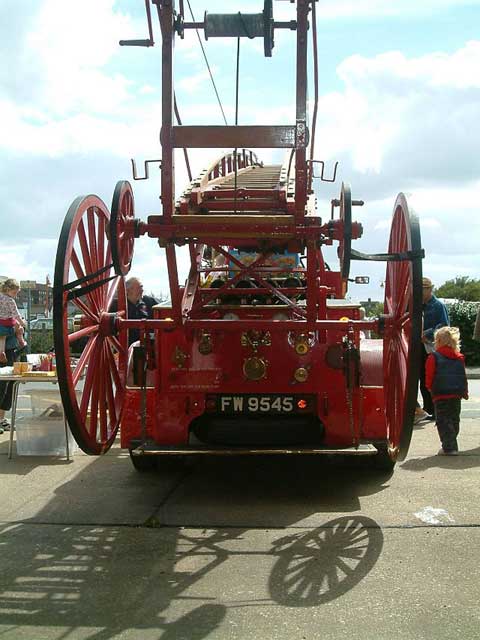
Getting it off, must be first on the list of "Things To Do Upon Arrival At Fire Scene"; to clear the Pump Panel.
I can see the 2 Safety Straps, to keep "little hands" from spinning those big carriage-wheels.....
Has any-one got photos of a Wheeled Escape being deployed ?
Were they used in countries, outside of the British influence ?
It is so representative of the old classic British Fire-Engine - and there are a lot of us Readers, who have only seen them in pictures, hence my curiosity.
Regards, from Canada,
Pat_R-B
Added by Pat Rivers-Bowerman on 07 October 2008.