
Upload a Picture
About this Site | Links | Random Pic | Advanced Search
Home | Latest Additions | Contributors
| Visitors
Fire Engine Photos
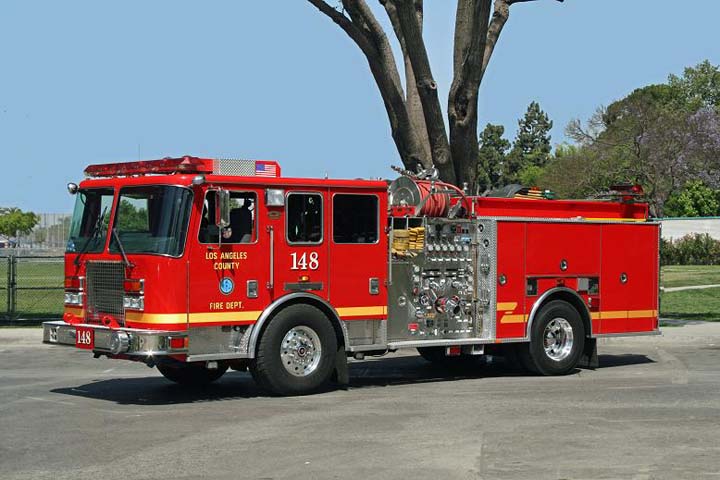
No: 10517 Contributor: Shane MacKichan Year: 2006 Manufacturer: KME Country: United States of America
Rob, you may be interested to know that Philadelphia has consistently put a booster reel on all their engines, including the newest fleet of KMEs.You might say their brush responses are fairly limited?
Added by Warren W. Jenkins on 07 November 2013.
Added by Warren W. Jenkins on 07 November 2013.
Atlanta is one of a small number of city departments which has continued to order new engines with booster reels, too. But - as you mentioned in your post about the Detroit Seasgrave ladder with booster equipment - a large number of US fire departments have abandoned them.
I agree that they are very useful at trash, car and vegetation fires, and much easier to operate during overhaul operations, but there is a school of thought in the US that the 40 GPM or so which they can deliver is just not enough to handle a structure fire.
I recently saw Brussels firefighters tackle a well-involved three storey row house fire with three booster lines, and they worked just fine! Two pumpers did the work, each drawing from a hydrant, and one line was operated from one of the two aerials which attended.
So I have to agree these are not "just" for brush fires!
But I think they are especially useful at brush fires. When I have seen LA City and LA County tackling brush fires, I did observe that the City's use of 1 inch crosslays did require a very lengthy takeup, including washing the CAFS foam off the hoses before restowing them - and making any relocation of the pumper a very lengthy procedure. The County members just electrically rewound their booster lines! Both Californian and Australian brush pumpers with "pump and roll" capabilities also have booster reels, as do all European off-road pump-tankers, so members can ride
or walk alongside and operate them - which could not work with flat hose.
In Sweden, some apartment buildings have high-pressure dry risers, which are specifically designed to be used with high pressure booster hoses, operating at a pump pressure of 588 PSI!
The pumper's reel is coupled to the outside dry riser inlet, and the crew take a short backpack booster hose line and nozzle inside for the attack.
Different strokes for different folks!
Added by Rob Johnson on 07 November 2013.
I agree that they are very useful at trash, car and vegetation fires, and much easier to operate during overhaul operations, but there is a school of thought in the US that the 40 GPM or so which they can deliver is just not enough to handle a structure fire.
I recently saw Brussels firefighters tackle a well-involved three storey row house fire with three booster lines, and they worked just fine! Two pumpers did the work, each drawing from a hydrant, and one line was operated from one of the two aerials which attended.
So I have to agree these are not "just" for brush fires!
But I think they are especially useful at brush fires. When I have seen LA City and LA County tackling brush fires, I did observe that the City's use of 1 inch crosslays did require a very lengthy takeup, including washing the CAFS foam off the hoses before restowing them - and making any relocation of the pumper a very lengthy procedure. The County members just electrically rewound their booster lines! Both Californian and Australian brush pumpers with "pump and roll" capabilities also have booster reels, as do all European off-road pump-tankers, so members can ride
or walk alongside and operate them - which could not work with flat hose.
In Sweden, some apartment buildings have high-pressure dry risers, which are specifically designed to be used with high pressure booster hoses, operating at a pump pressure of 588 PSI!
The pumper's reel is coupled to the outside dry riser inlet, and the crew take a short backpack booster hose line and nozzle inside for the attack.
Different strokes for different folks!
Added by Rob Johnson on 07 November 2013.
KME


Added by Rob Johnson on 06 November 2013.